
Contact Info

Hostnali Webhost Limited

+254 748285257

[email protected]

ORDER NOW

As a website or online business grows, the hosting requirements can change significantly. A small website may perform perfectly well on shared hosting, while a growing business may eventually require VPS hosting.

But what happens when your website or application outgrows a VPS?

This is where dedicated servers come in.

A dedicated server gives your business an entire physical server rather than sharing server hardware with other hosting customers. This provides greater control, performance, security, and resource availability.

But a dedicated server isn’t necessary for everyone.

In this guide, we’ll explain what dedicated servers are, who needs one, how they compare with VPS hosting, and what Kenyan businesses should consider before making the investment.
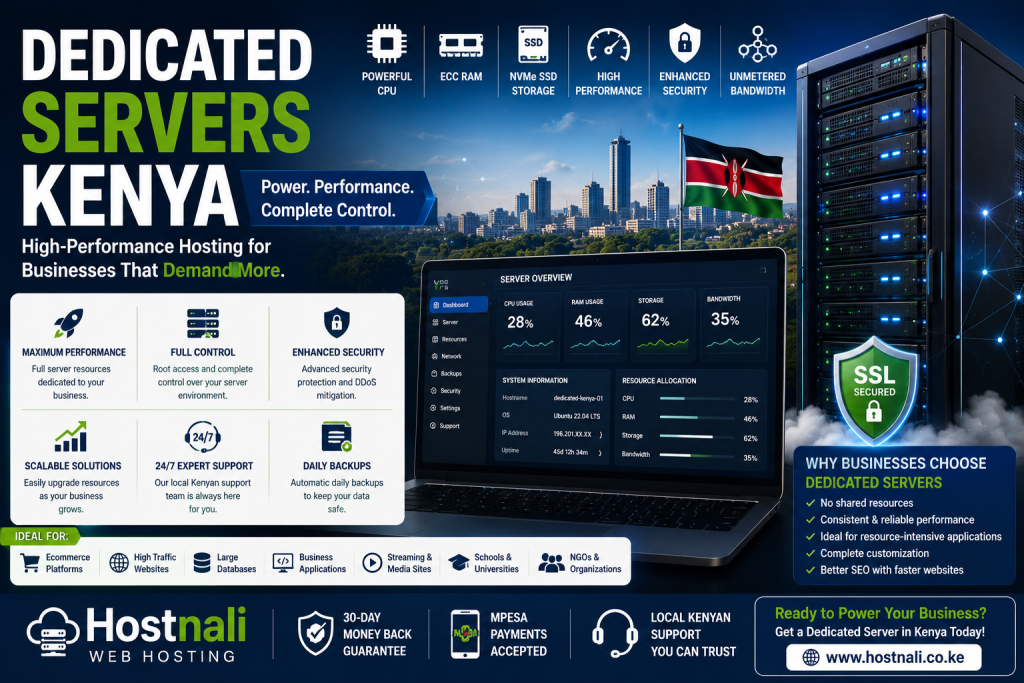
Dedicated Servers Kenya


Quick Answer: Who Needs a Dedicated Server?

A dedicated server is generally suitable for organizations that require:

  • High and consistent server performance
  • Large amounts of CPU and RAM resources
  • High-traffic websites
  • Large ecommerce platforms
  • Complex web applications
  • High-traffic databases
  • Custom server configurations
  • Greater control over the hosting environment

For a small business website or new blog, shared or WordPress hosting is usually sufficient.

For a growing website, VPS hosting may be the better intermediate step before moving to a dedicated server.


What Is a Dedicated Server?

A dedicated server is a physical server reserved for one customer or organization.

Unlike shared hosting, where many websites use the same server resources, a dedicated server gives you access to the entire machine.

You can typically configure:

  • CPU
  • RAM
  • Storage
  • Operating system
  • Security settings
  • Applications
  • Server software

This makes dedicated hosting suitable for businesses with demanding workloads.


How Does Dedicated Hosting Work?

With shared hosting, multiple customers share one physical server.

With VPS hosting, a physical server is divided into multiple virtual environments.

With dedicated hosting, your organization uses the entire physical server.

Simple comparison:

Shared Hosting → Shared server resources

VPS Hosting → Virtual dedicated resources

Dedicated Server → Entire physical server

The more demanding your website or application becomes, the more resources and control you may require.


Dedicated Server vs VPS Hosting

Feature VPS Hosting Dedicated Server
Physical hardware Shared Entire server
Resources Allocated virtual resources Entire server resources
Performance High Very high
Scalability Excellent Excellent
Customization High Very high
Cost Lower Higher
Best for Growing businesses High-demand businesses
Server control High Maximum

A VPS is often the logical choice for businesses that need more resources without the cost of a dedicated server.


Who Needs a Dedicated Server?

1. Large Ecommerce Businesses

Large online stores can generate significant traffic and database activity.

A dedicated server can provide the resources needed to handle:

  • Large product catalogues
  • Thousands of visitors
  • Customer accounts
  • Shopping carts
  • Order processing
  • Inventory systems

For ecommerce businesses, consistent performance can be particularly important during sales and promotional campaigns.


2. High-Traffic Websites

Websites receiving large amounts of traffic can place significant demands on hosting infrastructure.

Examples include:

  • News websites
  • Media platforms
  • Large blogs
  • Online communities
  • Publishing platforms

A dedicated server provides greater resources for handling high visitor volumes.


3. Large Organizations

Organizations with complex websites and applications may need more control over their hosting environment.

Examples include:

  • Universities
  • Large NGOs
  • Corporations
  • Government-related organizations
  • Financial technology companies

These organizations may also require customized server configurations.


4. Businesses Running Resource-Heavy Applications

Some applications require significant CPU, RAM, storage, or database resources.

Examples include:

  • CRM systems
  • ERP applications
  • Business management platforms
  • Large databases
  • Custom web applications

A dedicated server can provide the resources these applications require.


5. Businesses Requiring Greater Server Control

Dedicated servers are useful when you need extensive control over the server environment.

Depending on the hosting arrangement, you can configure:

  • Operating system
  • Software packages
  • Security settings
  • Databases
  • Server applications
  • Performance configurations

This is particularly valuable for developers and organizations with technical teams.


6. Businesses With Strict Resource Requirements

With shared hosting, resources are distributed among multiple customers.

With a dedicated server, the physical resources are reserved for your organization.

This can provide more predictable performance for demanding applications.


When You Don’t Need a Dedicated Server

Not every website requires a dedicated server.

You probably don’t need one if you’re running:

  • A small business website
  • A personal blog
  • A portfolio website
  • A new WordPress website
  • A small online store
  • A low-traffic informational website

For these websites, shared hosting or WordPress hosting may provide everything you need.


VPS Hosting May Be the Better Choice

Before moving directly from shared hosting to a dedicated server, consider VPS hosting.

VPS hosting provides:

  • Dedicated virtual resources
  • Better performance
  • Greater control
  • Improved scalability
  • Lower costs than dedicated hosting

For many growing Kenyan businesses, a VPS offers an excellent balance between performance and affordability.


Signs You May Need a Dedicated Server

Your business may be ready for dedicated hosting if you consistently experience:

1. High Resource Usage

Your VPS or current hosting plan frequently reaches its CPU or RAM limits.

2. Traffic Growth

Your website receives significantly more visitors than your current hosting environment can comfortably handle.

3. Database Performance Problems

Large databases may require additional CPU, RAM, or storage resources.

4. Application Requirements

Your application requires software or configurations unavailable on shared or VPS hosting.

5. Performance Demands

Your business depends heavily on consistently fast website or application performance.

6. Greater Control

You need complete control over your server environment.


Benefits of Dedicated Servers

Better Performance

Your applications have access to the server’s physical resources without competing with other customers.

Greater Control

You have more freedom to configure the server according to your requirements.

Improved Scalability

You can select hardware with the CPU, RAM, and storage capacity your applications require.

Enhanced Isolation

Your server environment is physically isolated from other hosting customers.

Custom Configurations

Dedicated servers are suitable for specialized applications requiring particular software and server configurations.


What to Consider Before Buying a Dedicated Server

CPU

Consider the number of processor cores and processing requirements of your applications.


RAM

Memory requirements depend on your:

  • Website traffic
  • Databases
  • Applications
  • Number of simultaneous users

Storage

Choose between storage technologies and capacities according to your application requirements.

For performance-focused websites, fast SSD or NVMe storage can be particularly useful.


Bandwidth

High-traffic websites need sufficient bandwidth to serve visitors and deliver large files.


Server Management

Determine whether you need a managed or unmanaged dedicated server.

Managed Server

The provider assists with server administration, updates, monitoring, and maintenance.

Unmanaged Server

You or your technical team handles server administration.


Dedicated Servers for Kenyan Businesses

A dedicated server can be particularly useful for Kenyan businesses that have reached a stage where website performance and reliability are directly connected to business operations.

Potential users include:

  • Large ecommerce companies
  • Financial technology businesses
  • Universities
  • Media companies
  • Large NGOs
  • Software companies
  • High-traffic publishers
  • Hosting companies

However, the correct hosting solution depends on the actual resource requirements of the organization.


Why Choose Hostnali for Dedicated Server Hosting?

Hostnali provides hosting solutions for businesses that need to scale beyond standard shared hosting.

Dedicated server customers can benefit from an infrastructure-focused hosting environment designed for demanding websites and applications.

When evaluating a dedicated server solution, businesses should consider:

  • Server performance
  • Storage technology
  • Available resources
  • Security
  • Backup options
  • Technical support
  • Upgrade options
  • Server management

Hostnali can help businesses determine which hosting environment best fits their requirements before upgrading.


Frequently Asked Questions

What is a dedicated server?

A dedicated server is a physical server reserved for a single customer or organization.

Is a dedicated server better than VPS hosting?

Not necessarily for everyone. Dedicated servers provide more physical resources and control, but VPS hosting can be more affordable and sufficient for many growing businesses.

How much does a dedicated server cost in Kenya?

The cost depends on the server’s CPU, RAM, storage, bandwidth, management, and other features. Businesses should compare specifications rather than choosing based on price alone.

Can I host multiple websites on a dedicated server?

Yes. A dedicated server can host multiple websites and applications, provided its resources are sufficient for the workloads.

Should a small business buy a dedicated server?

Usually not. Small businesses can often start with shared, WordPress, or VPS hosting and upgrade when their resource requirements increase.


Final Thoughts

Dedicated servers provide the highest level of physical resource allocation and server control among the hosting options discussed in this guide.

However, more powerful hosting isn’t automatically better hosting.

If you operate a small website, shared or WordPress hosting may be enough. If your business is growing, VPS hosting can provide the additional resources you need. A dedicated server becomes more appropriate when your workloads require substantial resources, consistent performance, or extensive server customization.

The best approach is to choose hosting based on your actual traffic, application requirements, resource usage, and business growth plans.

Ready to determine whether your business needs a dedicated server?

Explore Hostnali hosting solutions and choose a hosting environment that can grow with your website.

Share this Post