 KES
 UGX - Uganda
 TZS - Tanzania
 RWF - Rwanda
 NGN - Nigeria
 ZAR - South Africa
 USD - Zimbabwe
 GHS - Ghana
 ETB - Ethiopia
 ZMW - Zambia
 USD - International

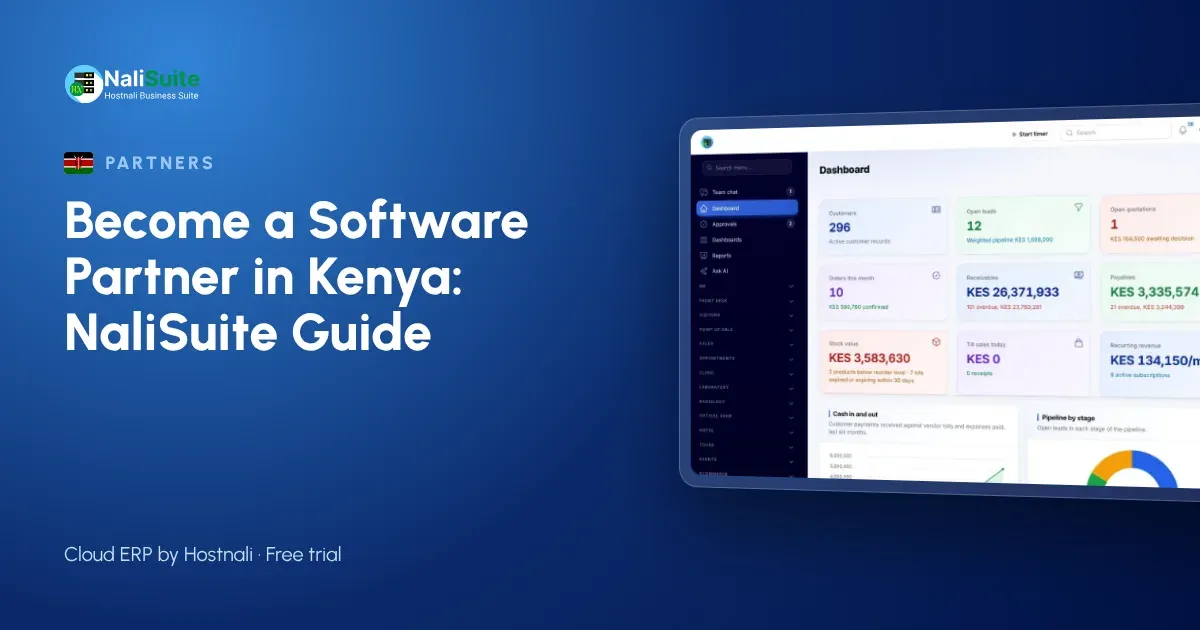
If you already look after other people’s books, websites or computers in Kenya, your clients probably ask you which software they should use. Becoming a software partner turns that advice into recurring income, and it makes your own work easier because every client sits on the same system.
This guide explains how the NaliSuite partner programme works, who it suits and how to start without changing the way you run your practice.
Who the programme is built for
The NaliSuite partner programme is open to people who set up and support business software for small and medium businesses. In Kenya that usually means:
- Accountants and bookkeepers who chase clients every month for receipts, M-Pesa statements and sales records.
- Business consultants who help companies tidy up processes before they grow.
- IT companies that install networks, printers and email for offices in Nairobi, Mombasa or Nakuru.
- Web designers and Hostnali resellers who already sell websites and hosting and want a second product for the same clients.
You do not need to be a software developer. NaliSuite runs in the browser, so there is nothing to install on a server.
How the 20% recurring commission works
Partners earn 20% of the subscriptions they bring in, every billing period, for as long as the client stays on NaliSuite. If a client pays monthly, you earn each month. If they move to a yearly plan, you earn on the yearly payment.
Because it is recurring, the value grows with your client list rather than resetting each month. Plans start from Ksh 250 a month, and every plan includes all 17 built-in apps, so you are not selling a confusing list of modules. The full terms are published on nalisuite.com/partners.
A worked example: a bookkeeping practice in Nakuru
Picture a small bookkeeping firm with 15 retail and service clients. Today each one sends a WhatsApp photo of receipts, a spreadsheet of sales and an M-Pesa statement at month end. The bookkeeper spends the first week of every month retyping.
Over three months the firm moves eight of those clients onto NaliSuite:
- Each client’s invoices, bills and M-Pesa payments now post to accounting as they happen.
- The bookkeeper logs in to each client’s account instead of waiting for files.
- Month-end work shrinks to reviewing and reconciling, not data entry.
- The firm earns 20% of all eight subscriptions every billing period.
The commission is useful, but the bigger win is time: the practice can take on more clients with the same staff.
What a partner actually does
Being a partner is mostly the work you already do, done in one place:
- Recommend the right plan based on users and storage.
- Set up the company: country pack, chart of accounts, VAT, KRA PIN details and opening balances.
- Connect payments so customers can pay invoices by M-Pesa or Airtel Money.
- Train the owner and staff for an hour or two.
- Support them afterwards, or hand routine questions to NaliSuite’s own help centre.
Many partners charge their own setup or training fee on top. That is between you and your client.
Kenya-specific setup you can offer
Kenyan clients value help with the things that are tedious to learn alone:
- Connecting KRA eTIMS. NaliSuite provides the connection; the client registers and gets their own eTIMS credentials, and you can guide them through it.
- Setting up payroll with the statutory deductions handled in the country pack.
- Importing M-Pesa paybill or till statements so reconciliation works from the first month.
When you handle client data, keep the Data Protection Act 2019 in mind and agree in writing what you can access. The Office of the Data Protection Commissioner publishes guidance for businesses that process personal data.
Questions to answer before you join
A short honest check saves you from signing up and then doing nothing with it:
- How many of your current clients still run their business on spreadsheets, paper or several disconnected apps?
- Do you have someone in the team who enjoys setting up systems and training people?
- Will you offer setup as a paid service, or include it in your monthly retainer?
- Which industries do you know best? The industries hub shows which add-ons fit each sector.
If the answers point to a handful of willing clients and one person who can own the setups, you are ready.
Moving clients from other software
Some of your clients will be on QuickBooks, Xero, Tally or plain Excel. The QuickBooks and Xero sync and Tally and Odoo migration add-ons help you move or connect them without starting from scratch.
How to get started
- Apply on nalisuite.com/partners.
- Get your partner account and materials.
- Start with two or three friendly clients and set them up properly.
- Write down your setup checklist so the next client takes half the time.
- Add NaliSuite to your proposals and engagement letters.
If you also sell hosting, look at reseller hosting so websites, email and business software come from one relationship.
Frequently asked questions
Do I need to be a registered accountant?
No. Accountants, bookkeepers, consultants, IT companies and web agencies that work with small and medium businesses can apply.
How much do partners earn?
20% recurring commission on the subscriptions you bring in, every billing period, for as long as the client stays.
Can I charge my clients for setup?
Yes. Setup, training and support fees are yours to agree with your clients.
Where are the full terms?
On nalisuite.com/partners, where you also apply.
Try NaliSuite
Before you recommend it, use it. Start a free trial of NaliSuite, set up a sample company the way you would for a client, and see how much of your month-end work it removes.