 KES
 UGX - Uganda
 TZS - Tanzania
 RWF - Rwanda
 NGN - Nigeria
 ZAR - South Africa
 USD - Zimbabwe
 GHS - Ghana
 ETB - Ethiopia
 ZMW - Zambia
 USD - International

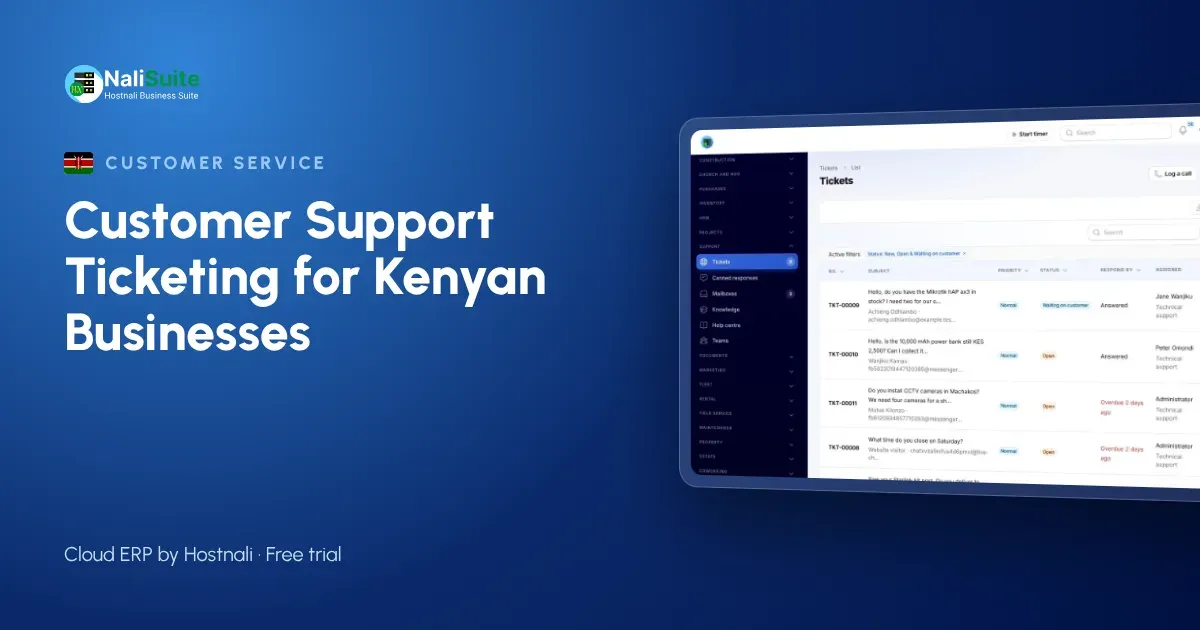
Every growing Kenyan business reaches the point where customer questions come from too many places at once: the shared email address, the office line, WhatsApp, the Facebook page and the contact form on the website. Nobody is sure who answered what, and the customer who waited three days posts about it.
A ticketing system fixes this by turning every question into a record with an owner, a priority and a deadline. Here is how it works, using a home internet provider in Nakuru as the example.
Why a shared inbox stops working
A fibre internet provider in Nakuru connects homes and small offices in Milimani, Section 58 and London estate. It has a support team of five. Customers report outages, ask about bills, request relocations and want to upgrade their package.
At first, everyone read the shared support email and answered whatever they saw. It broke down quickly:
- Two agents replied to the same customer with different answers.
- Urgent outage reports sat behind billing questions.
- WhatsApp messages went to one agent’s phone and were lost when she was off.
- Nobody could say how long customers were waiting.
What a ticket actually is
A ticket is one customer request with everything attached: the messages, who owns it, its priority, its status and how long it has been open. In NaliSuite Helpdesk, tickets arrive from email, web forms, phone calls, live chat, Facebook Messenger, Instagram and WhatsApp into one inbox.
Each ticket moves through simple statuses: New, Open, Waiting on customer, Resolved. When the customer replies, the ticket opens again for the same agent, with the whole history visible.
Priorities and response targets
Not every request is equally urgent. Agree priorities with your team and set targets for each. Helpdesk tracks first-response and resolution targets by priority and escalates tickets that are about to miss them.
| Priority | Example for an internet provider | First reply | Resolution |
|---|---|---|---|
| Urgent | Whole estate offline | 15 minutes | Same day |
| High | One customer offline | 1 hour | Next working day |
| Normal | Billing question, upgrade | 4 working hours | 2 working days |
| Low | General enquiry, feedback | 1 working day | 5 working days |
These are examples, not rules. Choose targets you can actually keep, then tighten them.
Routing tickets to the right people
The Nakuru provider split support into two teams: technical and accounts. Outage and speed tickets go to the technical team; billing and package changes go to accounts. Within each team, tickets are shared out by round robin, so no agent gets buried while others are quiet.
Answering faster without lowering quality
Canned replies
Questions like “how do I pay my bill?”, “what are your packages?” and “how do I restart my router?” come up every day. Save the best answer once as a canned reply, including your M-Pesa paybill and account format if that is how customers pay, and every agent can use it in seconds.
AI-drafted replies
With the AI Business Assistant add-on, NaliSuite drafts a reply from the conversation and your help articles. The agent reads it, edits it and sends it. The add-on uses your own Anthropic API key, so you control the data and the cost. More on this on the AI features page.
A help centre that answers questions for you
Many tickets are questions that a good article could answer. Publish knowledge base articles in a public help centre and in the customer portal: router set-up, how billing works, what to do during an outage. Every article that answers a common question is a ticket that never needs to be written.
In the customer portal, customers can also open and follow their own tickets, see their invoices and pay outstanding ones.
Measuring what matters
Once tickets are in one place, you can finally see:
- how many tickets arrive each day and on which channel;
- how long customers wait for a first reply;
- which tickets broke their targets, and why;
- how customers rated the help they got.
After a month the Nakuru provider saw that most urgent tickets came on Monday mornings after weekend outages, and moved a technician’s day off accordingly.
Billing support time
If you sell support, for example IT support to small offices, agents can log time on tickets and that time can be billed. It turns support from a cost into a service you can charge for.
Customer data
Tickets contain names, phone numbers, addresses and account details, which are personal data under Kenya’s Data Protection Act, 2019. Keep them in the helpdesk rather than on personal phones, and give agents access to what their team needs.
Frequently asked questions
Can WhatsApp messages become tickets?
Yes. Connect your WhatsApp Business number through the WhatsApp Business Cloud API and messages arrive as tickets. See the WhatsApp feature for details.
Can customers rate our support?
Yes. Customers can rate the help they received when a ticket is resolved.
Do we need a big team for this?
No. A ticketing system helps even two people, because it shows what is waiting and who is handling it.
Try NaliSuite
Helpdesk, the customer portal and a public help centre are built into every NaliSuite plan, from Ksh 250 a month. See the plans and connect your support email during the free trial.