 KES
 UGX - Uganda
 TZS - Tanzania
 RWF - Rwanda
 NGN - Nigeria
 ZAR - South Africa
 USD - Zimbabwe
 GHS - Ghana
 ETB - Ethiopia
 ZMW - Zambia
 USD - International

Kenya’s online sellers, pharmacies and wholesalers depend on couriers, and the competition between delivery businesses is fierce. Riders weave through Nairobi traffic, vans run up and down the Mombasa road, and customers expect to know where their parcel is at every step.
These tips are for courier and delivery owners who want to grow without losing track of parcels or cash.
A day at an example courier in Nairobi
An example courier with a depot in Nairobi’s industrial area runs eight riders and two vans. By 10 a.m. the morning’s parcels from online sellers have waybills priced from the rate card, and receivers have a tracking link by text. The vans leave for Thika and Nakuru with printed manifests; the riders take their runs across town. By evening every rider has handed over the day’s cash on delivery, and the sellers see what they are owed.
Waybills: the record that follows the parcel
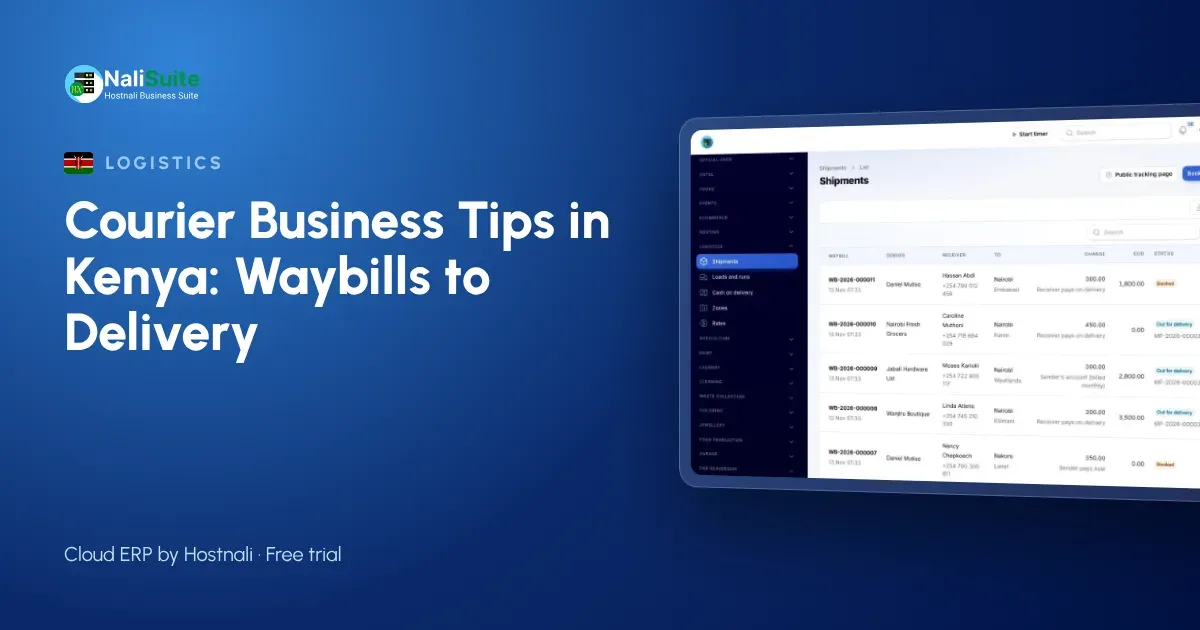
Each parcel needs a waybill with the sender, the receiver, their phone numbers, the destination zone and the price. Price it from a fixed rate card rather than negotiating each time, and print or text the waybill number to the sender so they can quote it when they call.
The NaliSuite courier add-on prices every waybill from your zone-to-zone rate card.
Send receivers a tracking link
Most calls to a courier office are some version of “where is my parcel?”. Answer them before they are asked: text the receiver a tracking link when the parcel is booked, and let them follow it on a tracking page.
In NaliSuite, tracking links go to receivers by text, with a tracking page to follow the parcel.
Organise line-haul and last-mile separately
Moving parcels between towns and delivering them to doors are different jobs. Plan line-haul loads between branches on one side and delivery runs for riders and vans on the other, and print a manifest for each so every parcel is accounted for at every step.
In NaliSuite’s logistics and courier add-on, loads and runs are planned with printed manifests.
Kenya: M-Pesa, eTIMS and receivers’ data
Many receivers pay cash on delivery by M-Pesa rather than cash, and account customers will want invoices with your KRA PIN. If your business must issue invoices through KRA eTIMS, NaliSuite provides the eTIMS connection and you use your own credentials. Receivers’ names, phone numbers and addresses are personal data under the Data Protection Act, 2019, so handle them carefully.
Proof of delivery ends the arguments
Disputes about deliveries are expensive because they cost you the parcel value and the customer’s trust. A photo taken at delivery, attached to the waybill, answers most of them in seconds.
In NaliSuite deliveries are confirmed with a photo as proof.
A simple routine for every delivery run
Before the run, the rider checks the parcels against the manifest. During the run, each delivery is confirmed with a photo and any cash on delivery is recorded. After the run, cash and failed deliveries come back to the depot and are checked off. The same routine every day keeps losses small.
Recording runs and collections per rider also shows you who needs support and who is ready for the busier routes.
Cash on delivery: count it every evening
Treat COD money as the sender’s money, because it is. Reconcile it against the delivery run every evening, rider by rider, and pay it over to senders on a schedule they can rely on. Late or missing COD payments are the fastest way to lose online sellers as customers.
NaliSuite tracks cash collected on delivery and pays it over to the sender.
Account customers keep the vans full
Regular senders are the backbone of a courier business. Give them an account, send them one invoice a month listing every waybill and make paying easy: M-Pesa or Airtel Money or card.
NaliSuite bills account customers monthly; Invoicing and payments take care of the rest.
Fleet costs: fuel, repairs and reminders
Track fuel for every vehicle, keep each one’s service and repair history and set reminders for insurance, licences and inspections before they expire. With trips and odometer readings recorded, you can see the cost per kilometre for each motorbike or van.
NaliSuite’s Fleet add-on covers fuel logs, service history, expiry reminders and cost per vehicle and per kilometre.
Mistakes that cost couriers money
- Quoting prices by phone instead of from a rate card.
- Letting cash on delivery sit with riders overnight.
- Handing parcels over between depot and truck without a manifest.
- Marking deliveries complete without proof.
- Not knowing the fuel cost of each route.
Each of these is cheap to fix once the records are in one place; the logistics section shows the NaliSuite apps that cover them.
Frequently asked questions
Can receivers pay cash on delivery by M-Pesa?
Yes. Collections are recorded against the delivery whichever way the receiver pays, and paid over to the sender.
How much does NaliSuite cost for a courier?
Plans start from Ksh 250 a month with all the built-in apps, and the courier add-on is an add-on to any plan.
Can I bill online sellers monthly?
Yes. Regular senders on account are billed monthly with every waybill listed.
Do I need to install anything?
No. NaliSuite runs in the browser on phones, tablets and computers.
Try NaliSuite
Ready to run deliveries on records instead of phone calls? NaliSuite starts from Ksh 250 a month with a free trial. Add the courier add-on and see the plans and prices.