 KES
 UGX - Uganda
 TZS - Tanzania
 RWF - Rwanda
 NGN - Nigeria
 ZAR - South Africa
 USD - Zimbabwe
 GHS - Ghana
 ETB - Ethiopia
 ZMW - Zambia
 USD - International

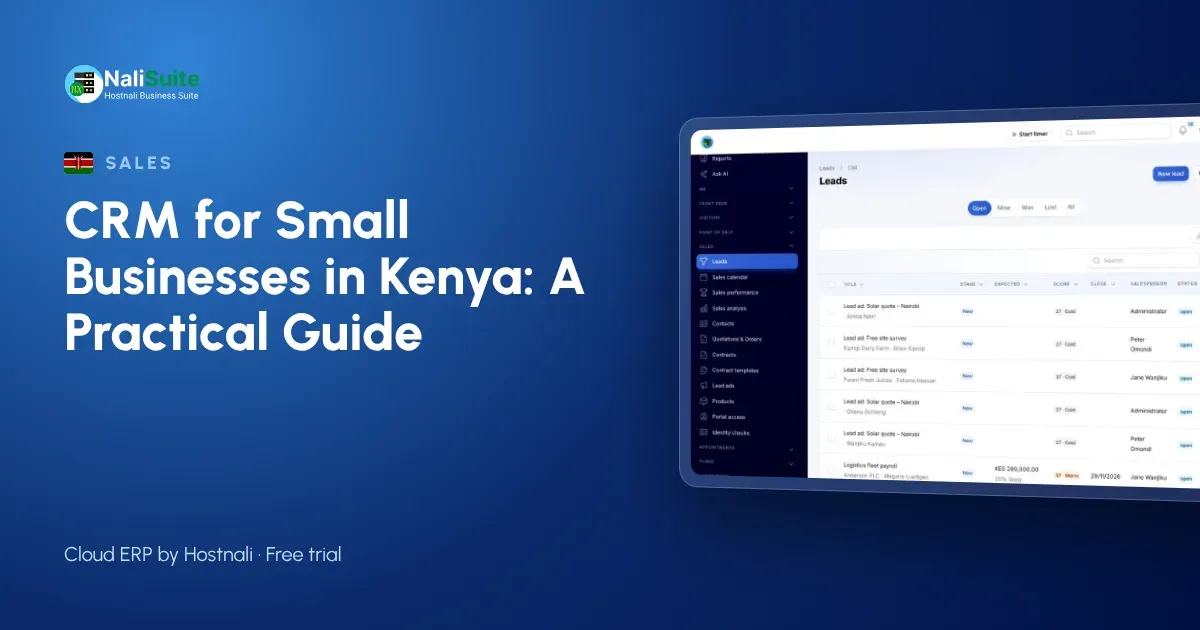
Most small businesses in Kenya do not lose customers because their product is weak. They lose them because a promising enquiry on WhatsApp was never followed up, or a quotation sat unanswered for two weeks.
A CRM fixes that by putting every lead, conversation and next step in one place. Here is how to use one well, without turning sales into paperwork.
What a CRM actually does
At its core, a CRM is a list of leads and customers with a history and a next step attached to each one. Everything else, from pipelines to reports, builds on that.
Pipeline stages that fit a small business
A pipeline is just the steps a lead goes through before buying. Start with something like this and adjust it:
| Column on the board | Moves on when |
|---|---|
| New | Someone takes ownership |
| In discussion | Needs and budget are clear |
| Quoted | The quotation is sent |
| Waiting | A follow-up date is set |
| Won / Lost | The customer decides |
Where your leads come from
Map where your enquiries actually come from, then connect each source to the CRM. Forms on your website and lead ads on Facebook and Instagram can create leads on their own, and WhatsApp messages can be turned into leads with one tap. Phone calls and walk-ins are added by hand.
Example: a solar installer in Mombasa
Take an example solar installer in Mombasa. Enquiries arrive on WhatsApp, from a Facebook ad, by phone and from the website. The owner kept them in a notebook and two WhatsApp groups. Leads from Diani and Kilifi were forgotten while the team was busy on installations in town.
With a CRM, every enquiry becomes a lead on one board. The salesperson books a site visit, sends a quotation from the system, and the customer pays a deposit by M-Pesa from a pay link. If a quotation goes unanswered for three days, the CRM reminds the salesperson to call. The owner sees how many installations are coming next month at a glance.
Follow-ups that do not slip
The fortune is in the follow-up. Give every lead a next step and a date. When the date arrives, the CRM reminds the owner of the lead. A simple rule works well: no lead without a next step.
From quotation to invoice
Use the same system for quotations as for leads. With NaliSuite Sales and Quotations, you send a quotation by email or WhatsApp, see when it is accepted, and convert it into an invoice in one step.
Taking deposits and closing the deal
In Kenya, a deposit by M-Pesa is often the moment a lead becomes a customer. Send the quotation with a pay link so the customer can pay the deposit straight away, and the deal moves to won automatically when the payment arrives. See M-Pesa payments in NaliSuite.
What to measure
| Measure | What it tells you |
|---|---|
| Leads by source | Which channels are worth your money |
| Conversion rate | How many leads become customers |
| Time to close | How long a typical sale takes |
| Lost reasons | Why customers say no |
Making the CRM part of the daily routine
A CRM only works if the team uses it. For a business with staff in the field, from installers in Mombasa to sales reps covering Nakuru and Eldoret, that means a CRM that works on a phone, not only on the office computer.
Start small: one pipeline, five stages, and a rule that every lead has a next step. Hold a 15-minute pipeline review every Monday where each person walks through their open deals. Within a month, the habit sticks, and the owner stops chasing updates on WhatsApp.
If you already invoice in NaliSuite, the CRM uses the same customers, so a won deal flows straight into a quotation and an invoice with an M-Pesa pay link.
Choosing a CRM that fits
When you compare CRMs, look past the feature list. What matters for a small business is that it works on a phone, takes leads from the channels you already use, sends quotations and invoices from the same records, and is priced in your currency. A standalone CRM that does not talk to your invoicing means typing every won deal twice. Ask for a free trial and run real leads through it for two weeks before deciding.
Customer data and the law in Kenya
A CRM holds personal data: names, phone numbers, locations. In Kenya that data is protected by the Data Protection Act, 2019, overseen by the Office of the Data Protection Commissioner (ODPC). Collect only what you need, tell customers why you keep it, and get consent before sending marketing messages.
Keeping customer data in one secured system, with access by role, is far safer than spreadsheets passed around on WhatsApp.
Frequently asked questions
Can I add leads from WhatsApp to a CRM?
Yes. In NaliSuite, WhatsApp conversations can create leads in the CRM pipeline, next to website forms, ads and phone calls.
Do I need consent to message leads in Kenya?
Get consent before sending marketing messages, as the Data Protection Act requires, and keep a record of it on the contact.
Should I build my own CRM in a spreadsheet?
It works for a handful of leads, but reminders, sharing and history quickly outgrow a spreadsheet.
Can I import my existing contacts?
Yes. Upload an Excel or CSV file and match the columns to fields such as name, phone and email.
Try NaliSuite
Try the NaliSuite CRM free, with quotations and invoicing built in. Plans start at Ksh 250 a month. View plans.