 KES
 UGX - Uganda
 TZS - Tanzania
 RWF - Rwanda
 NGN - Nigeria
 ZAR - South Africa
 USD - Zimbabwe
 GHS - Ghana
 ETB - Ethiopia
 ZMW - Zambia
 USD - International

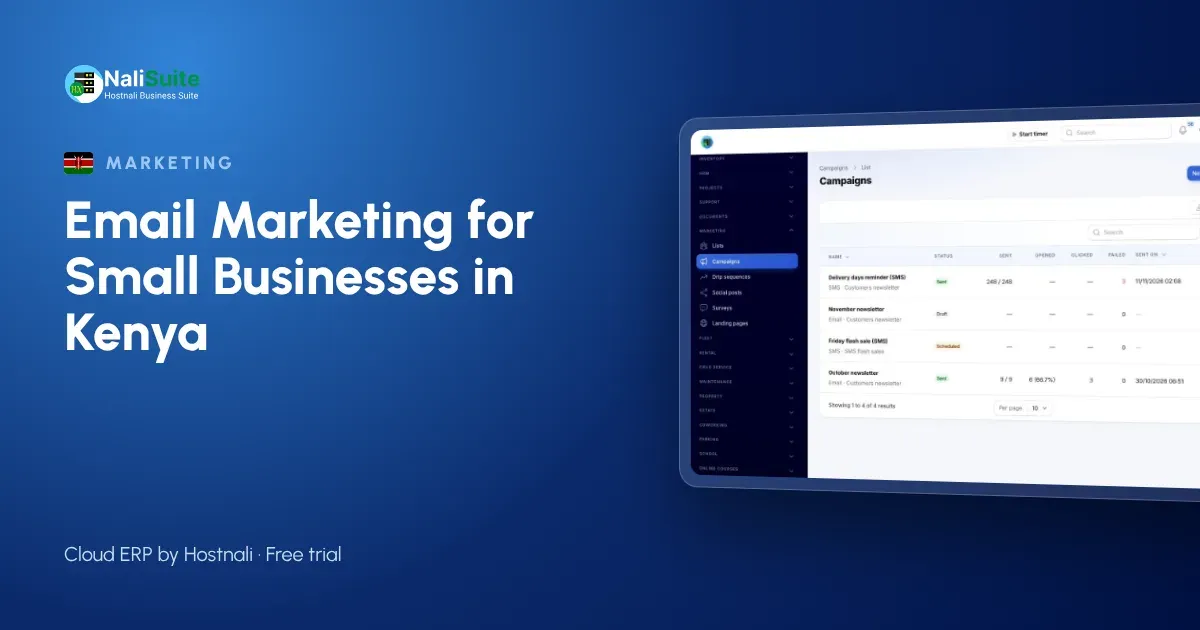
Kenyan small businesses tend to put their marketing effort into WhatsApp status updates, Facebook and Instagram. Those channels matter, but you do not own them: a change to an algorithm or a banned account can cut you off from your customers overnight. An email list is different. It belongs to you, and the people on it asked to hear from you.
This guide covers email marketing for a small business in Kenya from the ground up: building a list properly, deciding what to send, writing emails people open, getting them delivered and staying within the Data Protection Act.
Why email still earns its place
Email is not the newest channel, but it has three strengths that matter to a small business:
- You control the list. Customers who sign up stay on it until they choose to leave.
- It suits considered purchases. A school choosing a supplier, or a company comparing office furniture, reads detailed emails in a way they do not read social posts.
- It is measurable. You can see who opened, who clicked and what they bought afterwards.
It also works well alongside the channels Kenyans already use. An email can announce an offer in detail, while a WhatsApp message to opted-in customers reminds them of it.
Building a list the right way
Start with people who already know you
Your existing customers are the best place to begin. In NaliSuite, the contacts app already holds the customers you invoice and sell to. Ask them whether they would like to receive news and offers, and record who says yes.
Add sign-up points
- A subscribe form on your website. The NaliSuite marketing app includes landing pages and subscribe forms that feed your lists directly.
- A tick box on your quotation or order form.
- A QR code at the till in your Nairobi or Mombasa shop that opens the sign-up form.
- A line in your email signature.
Never buy lists
Bought lists contain people who never agreed to hear from you. They complain, they mark you as spam and they damage the reputation of your sending domain. Under the Data Protection Act they are also a legal risk.
What to send: a simple calendar
You do not need a weekly newsletter to start. A small business can run on a monthly rhythm:
| Week | |
|---|---|
| 1 | Something useful: a tip, a guide or an answer to a common question |
| 2 | A product or service spotlight, with a clear price or “from” price |
| 3 | A customer story or behind-the-scenes look, with permission |
| 4 | An offer, if you have one, or a reminder of seasonal needs |
Kenyan seasons give you natural topics: back-to-school in January, May and September, end-of-year shopping, and the start of the financial year in July for business customers.
Writing emails people open
- Subject lines of a few words that say what is inside: “New stock of school shoes in Nakuru” beats “Our November newsletter”.
- One main message per email, with one clear button.
- A real sender name, such as “Wanjiru at Kamau Hardware”, not “noreply”.
- Short paragraphs, because most people will read on a phone.
- Prices and payment options stated clearly, including whether customers can pay by M-Pesa.
Getting delivered, not filtered
Emails sent from a free webmail address to hundreds of people are likely to land in spam. Send from an address on your own domain, and make sure the domain has the usual authentication records (SPF, DKIM and DMARC) set up. Hostnali’s business email hosting gives you addresses on your domain, and our team can help with the records.
Keep the list clean as well: remove addresses that bounce, and let people leave easily. In NaliSuite every campaign email has an unsubscribe link, and contacts who opt out are skipped automatically.
Measuring what works
After each campaign, look at:
- opens and clicks, to see which subjects and offers interest people;
- replies and enquiries, which often matter more than clicks for service businesses;
- sales that followed, which you can see when campaigns and sales live in the same system, as with the CRM and sales apps in NaliSuite.
Compare your own campaigns with each other rather than with industry averages. If tips get more clicks than offers, send more tips.
Follow-ups that run themselves
Drip sequences send a series of emails automatically when someone joins a list. A simple welcome sequence might be:
- Day 0: thank you and what to expect.
- Day 3: your most popular product or service.
- Day 7: answers to the questions new customers ask most.
- Day 14: a reason to buy now, such as a seasonal offer.
Set it up once and every new subscriber gets the same good introduction.
Email marketing and the Data Protection Act
Kenya’s Data Protection Act, 2019 sets rules on using personal data for direct marketing, and the Office of the Data Protection Commissioner (ODPC) enforces it. In practice: get clear consent, record when and how people signed up, give an easy way to opt out in every email, and honour opt-outs promptly. Check the ODPC’s current guidance on direct marketing for the details that apply to you.
Frequently asked questions
How often should a small business send emails?
Once or twice a month is a good start. Consistency matters more than frequency.
Can I send SMS campaigns from the same place?
Yes. NaliSuite’s marketing app sends email and SMS campaigns once you connect a supported SMS provider, and WhatsApp broadcasts to opted-in customers.
Do unsubscribes work automatically?
Yes. Every email has an unsubscribe link and opted-out contacts are skipped.
Do I need a separate email marketing tool?
Not if you use NaliSuite. Campaigns, lists and sequences are part of the built-in marketing app on every plan.
Try NaliSuite
Run email, SMS and WhatsApp campaigns from the customer data you already have. See the NaliSuite plans, starting at Ksh 250 a month, and start a free trial.