 KES
 UGX - Uganda
 TZS - Tanzania
 RWF - Rwanda
 NGN - Nigeria
 ZAR - South Africa
 USD - Zimbabwe
 GHS - Ghana
 ETB - Ethiopia
 ZMW - Zambia
 USD - International

A new hire’s first payslip says a lot about how organised an employer is. If the KRA PIN is missing, the SHIF deduction is wrong or the M-Pesa number has a typo, the new person’s first impression of your business is a phone call to fix it.
This checklist walks Kenyan employers through onboarding in four stages, from the signed offer to the end of the first month, with a worked example from a pharmacy group in Nakuru.
Stage 1: between the offer and the first day
Most onboarding problems start because nothing happens between “yes, I accept” and the Monday the person arrives. Use that gap.
- Send the contract and the offer letter and get them signed back. Keep the signed copy on the employee’s record, not in someone’s inbox.
- Collect the payroll details: KRA PIN, NSSF number, SHIF number, national ID, bank account or M-Pesa number, and next of kin.
- Agree the start date, hours and reporting line in writing.
- Prepare the workstation: login, email address, phone, uniform or tools, whatever the role needs.
- Pick a buddy, a colleague who will answer the small questions in week one.
If a detail is missing, chase it now. Payroll cut-off will not wait for a PIN that arrives on the 28th.
Stage 2: the first day
The first day should feel planned, not improvised.
- Welcome the new person and introduce the team they will work with.
- Walk through the workplace rules: hours, breaks, leave, how to report absence, and who approves what.
- Install the employee app on their phone and show them how to check in, apply for leave and find their payslips.
- Hand over equipment and record what was issued.
- End the day with their manager: what good looks like in the first week.
Stage 3: the first week
By Friday the new hire should know their main tasks and have done some real work. Schedule short check-ins on day three and day five. Ask what is unclear, not just whether everything is fine.
This is also the week to finish any training the role needs and to confirm that HR has every document on file.
Stage 4: the first month and the first pay run
The first pay run is where onboarding is tested. Before you run it, check:
| Item | Why it matters |
|---|---|
| KRA PIN on the employee record | PAYE goes on the P10 return under that PIN |
| NSSF and SHIF numbers | Contributions are posted against them |
| Pay start date | A mid-month start means a pro-rated first salary |
| Payout details | Bank or M-Pesa, checked against the ID name |
NaliSuite works out PAYE, NSSF (6% employee and 6% employer, up to the NSSF upper earnings limit), SHIF at 2.75% of gross pay and the 1.5% Affordable Housing Levy for both employee and employer. The returns are due by the 9th of the following month, so a hire who starts late in the month still needs to be on that month’s schedules. Rates change from time to time: check current rules with the Kenya Revenue Authority before your first run, and adjust the settings in NaliSuite if anything has moved.
You can test a salary before the first run with the PAYE calculator.
A worked example: three new pharmacists in Nakuru
A pharmacy group with four branches in Nakuru and Naivasha hired three pharmacists in the same month. In the past, the owner kept a paper file per person and typed payroll details into a spreadsheet. One new hire went unpaid for a week because her M-Pesa number was entered with a digit missing.
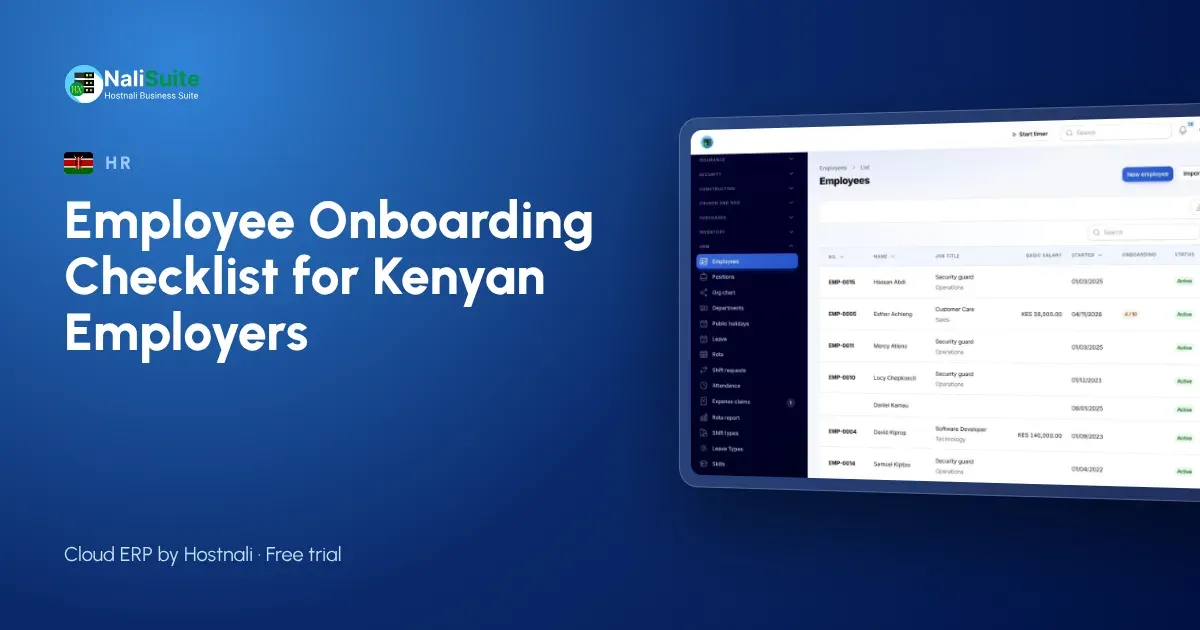
This time the HR officer created each employee in the HR app the day the offer was accepted. An onboarding checklist started automatically for each one: contract signed, ID copy uploaded, KRA PIN and NSSF number entered, phone app installed, branch induction done. The branch managers ticked off their own items. On payday every pharmacist got a payslip in the app and on WhatsApp, and the P10 schedule already included them.
Make onboarding repeatable
The point of a checklist is that it runs the same way whether you hire one person a year or ten a month.
- Start the checklist automatically when the employee record is created, so nobody has to remember.
- Give every task an owner: HR, the line manager or finance.
- Keep documents with the person: contracts, ID copies and certificates in Documents, linked to the employee.
- Let staff serve themselves: with employee self-service, the new hire checks leave, attendance and payslips on their phone instead of asking HR.
Look after personal data
Onboarding collects a lot of personal information: ID numbers, bank details, next of kin. Under Kenya’s Data Protection Act, collect only what you need, restrict who can see it and keep it secure. NaliSuite limits each user to what their role allows.
Frequently asked questions
What details do I need before the first payroll in Kenya?
The KRA PIN, NSSF number, SHIF number, national ID, start date, salary and the bank or M-Pesa account for payment.
Can the new hire fill in their own details?
They can use the employee app for leave, attendance, payslips and expense claims. HR enters and checks the payroll details on the employee record.
Does the onboarding checklist start by itself?
Yes. In the HR app, onboarding and offboarding checklists start automatically when someone joins or leaves.
Where do contracts and ID copies go?
On the employee record, with the files kept in Documents so they are easy to find and only visible to the right people.
Try NaliSuite
NaliSuite brings HR, payroll and the staff app into one system for Kenyan employers, from Ksh 250 a month with a free trial. See the plans and run your next hire through it.