 KES
 UGX - Uganda
 TZS - Tanzania
 RWF - Rwanda
 NGN - Nigeria
 ZAR - South Africa
 USD - Zimbabwe
 GHS - Ghana
 ETB - Ethiopia
 ZMW - Zambia
 USD - International

Walk into many Kenyan offices and you will still find box files on every shelf: lease agreements, delivery notes, receipts in envelopes, staff contracts, a carbon-copy invoice book. Paper feels safe because you can touch it. In practice it is slow to search, easy to lose, impossible to share from home and expensive to store.
Going paperless does not mean throwing everything away overnight. It means deciding, one document type at a time, to create, sign and store it digitally from now on.
What paper really costs you
Take a property agency in Nyali, Mombasa, with eight staff. It lets and manages apartments for landlords in Nyali, Bamburi and Shanzu. Before going paperless, it had:
- a room of lever-arch files with leases, inventories and tenant IDs;
- landlords phoning to ask for copies of documents that sat in Mombasa while they lived in Nairobi or abroad;
- leases printed, couriered and signed over a week, sometimes longer;
- receipts for repairs kept in an envelope until month end, some fading before they were entered;
- no reliable way to know which version of a lease was the final one.
Each of these costs time, and some cost money: a lost signed lease can cost a dispute.
What to digitise first
Not every document deserves the same effort. Start with the ones that are used often or that cause trouble when lost.
| Document | Why it comes first | Where it goes |
|---|---|---|
| Customer contracts and leases | Disputes, renewals, sharing | Documents, signed online |
| Supplier invoices and receipts | Tax records, month-end | Bills and expenses |
| Sales invoices and quotes | Payment, KRA records | Invoicing |
| Staff contracts and policies | Compliance, onboarding | HR and Documents |
| Old archives | Rarely used | Scan later, or keep boxed |
Six steps to a paperless office
1. Set up a folder structure
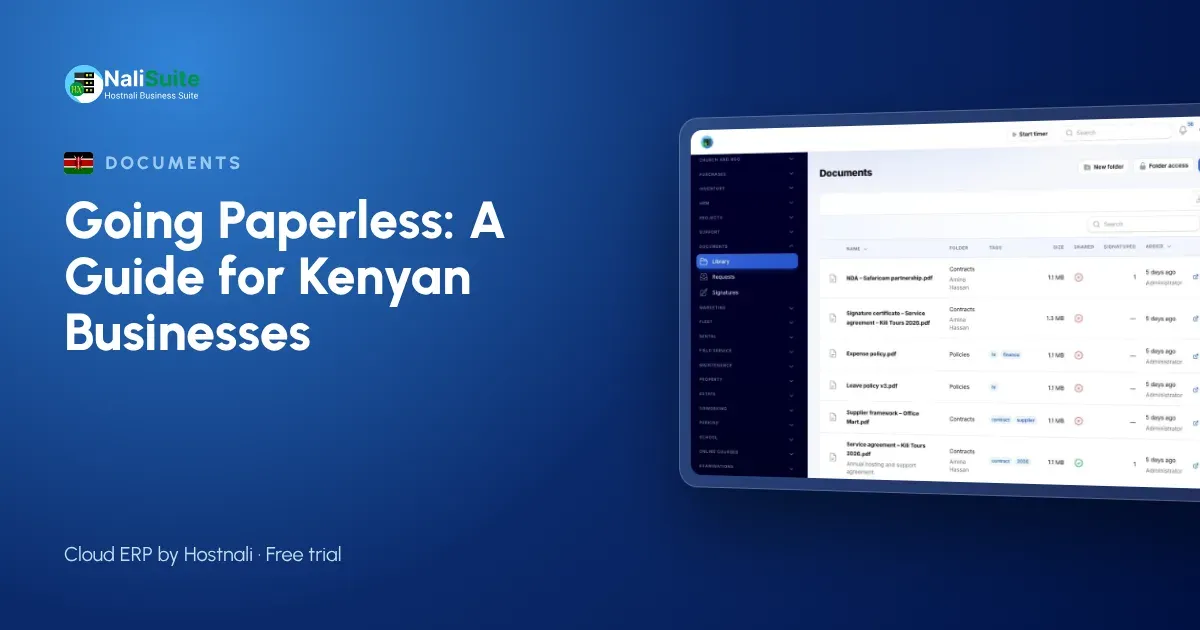
In NaliSuite Documents, create folders that match how you work: one per landlord or client, with sub-folders for contracts, statements and correspondence. Set access by role and person, so a letting agent sees tenancy files but not staff records.
2. Sign online instead of printing
Place signature fields on a lease or contract and send it for signing. The signer receives it by email, signs on a phone or computer, and you receive a stamped PDF with an audit certificate showing who signed, when and from where. A lease that took a week can be signed the same afternoon by a landlord in Nairobi and a tenant in Mombasa.
Each signature is recorded with that certificate, which supports its validity. Check the rules for your type of document in Kenya, because some documents may still need a particular form of signature or witnessing.
3. Stop typing receipts
With the Document AI add-on, supplier invoices and receipts are read for you and turned into bills or expenses, ready for someone to check. It uses your own Anthropic API key, so you control the data and the cost. More on the AI features page.
4. Invoice digitally
Raise quotes and invoices in NaliSuite Invoicing and send them by email or WhatsApp with an M-Pesa or card payment option. If you are registered for eTIMS, invoices can go through the KRA eTIMS connection once you have your own credentials from KRA.
5. Ask for documents digitally too
Instead of asking a tenant to bring a copy of their ID to the office, send a document request. They upload the file through a secure link or the customer portal, and you can track what has arrived.
6. Decide what happens to old paper
Scan the archive files you still use, keep the rest boxed and labelled, and stop adding to them. Within a year, the boxes become the exception.
Finding things again
Paperless only works if people can find documents faster than before. Use tags such as lease, inventory or renewal, and search by name or tag. Documents keeps every version, so when a lease is revised, the earlier version is still there but the latest is clear.
Sharing with customers
Landlords and tenants can download the documents shared with them from the customer portal, along with their invoices and statements. For the Mombasa agency, the “please send me a copy” calls almost stopped.
Data protection
Leases, IDs and payslips contain personal data protected under Kenya’s Data Protection Act, 2019. Digital files are easier to protect than a shelf of box files, but only if you use access control: give each person access to the folders they need, and no more.
Frequently asked questions
Are e-signatures accepted in Kenya?
Each signature comes with an audit certificate showing signer, time and IP address, which supports its validity. Check the rules for your type of document, as some may need a particular signature or witness.
Do I need to scan every old file?
No. Scan what you still use, and keep the rest archived. Focus on creating new documents digitally.
Can customers upload documents to us?
Yes. Send a document request and they upload through a secure link or the customer portal.
Try NaliSuite
Documents, Invoicing and the customer portal are built into every NaliSuite plan, from Ksh 250 a month. Look at the plans and sign your first contract online during the free trial.