 KES
 UGX - Uganda
 TZS - Tanzania
 RWF - Rwanda
 NGN - Nigeria
 ZAR - South Africa
 USD - Zimbabwe
 GHS - Ghana
 ETB - Ethiopia
 ZMW - Zambia
 USD - International

Opening a second branch is one of the proudest moments for a Kenyan business, and often the moment the old way of working stops. The notebook, the WhatsApp group and the end-of-day M-Pesa statement that worked for one shop start to hide stock losses and cash gaps once there are two.
A familiar story
Take a hardware business with shops in Kisii, Nakuru and Eldoret. Cement and iron sheets move between branches every week, each shop has its own till, and the owner reconciles M-Pesa paybill statements against three exercise books every Sunday. When a branch “runs out” of a product that the system says is in Nakuru, nobody can tell whether it was sold, moved or lost.
None of this is unusual. It is what happens when a business built around one owner in one place starts to run in several. The answer is not more WhatsApp groups. It is a system where every branch records the same things in the same way.
What each branch should record
| Area | What to record | Why it matters |
|---|---|---|
| Stock | Quantities per location, not one total | You see what is in Mombasa versus Nakuru |
| Transfers | Sent and received, both confirmed | Losses show up on the day |
| Sales | Every sale through the branch till | Takings match M-Pesa and cash |
| Cash | Opening float, closing count | Shortfalls are spotted daily |
| Costs | Rent, wages, transport per branch | You know which branch is profitable |
Setting it up step by step
- Create a location for each branch in Inventory, plus any central warehouse.
- Count opening stock at each location on the same day, and enter it.
- Open a till per branch in the point of sale, with its own float.
- Give every staff member a login, so every sale and transfer has a name on it.
- Add a cost centre per branch in the books, and post rent, wages and transport to it.
When a branch should be a separate company
Most branches are simply locations of one business: one set of books and one tax registration. A branch becomes a separate company when it is a separate legal entity, for example a subsidiary or a business in another country. NaliSuite keeps several companies under one login, each with its own books and taxes, as explained on the multi-company page.
A weekly branch routine
| When | Task |
|---|---|
| Daily | Close every till and record the cash count |
| Monday | Receive all transfers, including those to Eldoret |
| Midweek | Count the 20 fastest-moving products at each branch |
| Friday | Review branch sales and stock reports |
| Month end | Run profit and loss per branch |
Mistakes to avoid when opening a new branch
- Copying stock by hand. Opening stock for the new branch in Mombasa should be a transfer from an existing location, not a fresh count typed in, or the original branch’s stock will be wrong.
- Sharing one till login. When everyone uses the same login, nobody is responsible for the cash.
- Letting branches set their own prices. Unless you mean to, keep one price list so a customer pays the same in Nairobi and Nakuru.
- Ignoring branch costs. A branch with strong sales can still lose money after rent, wages and transport.
- Counting stock only once a year. Short weekly counts of fast movers catch problems while they are small.
What the owner sees each morning
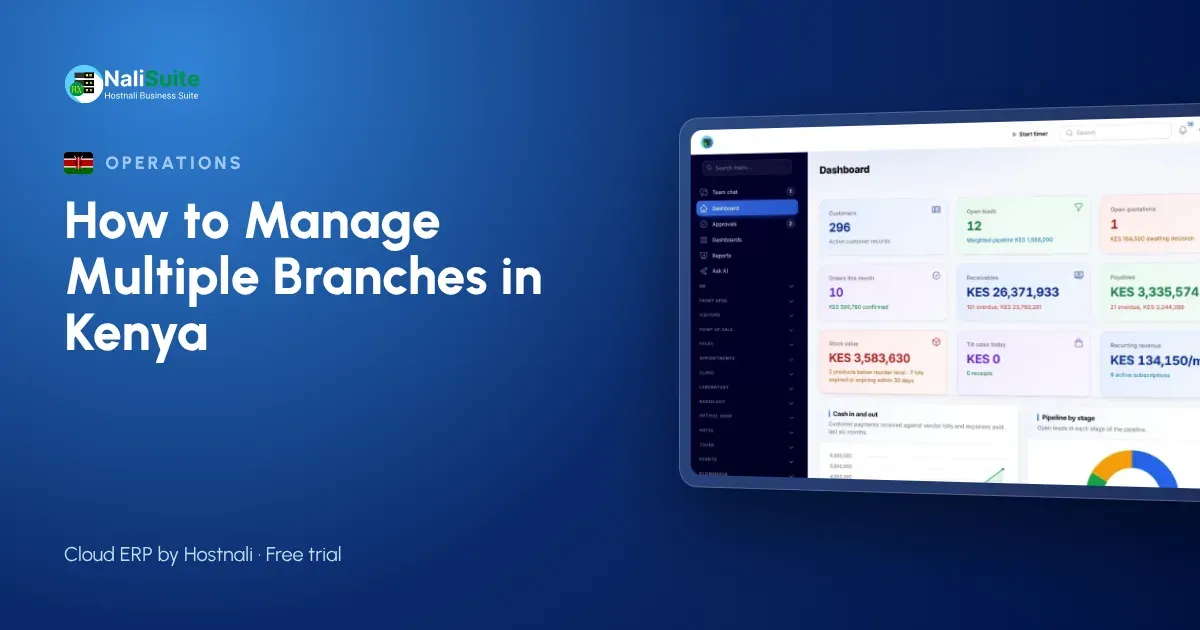
With every branch on the same system, the owner opens one dashboard instead of five WhatsApp messages: yesterday’s sales per branch, takings at each till, transfers not yet received in Eldoret and products about to run out. Questions that used to need a phone call to the branch manager are answered before the shops open.
That morning view also changes the conversation with branch managers. Instead of asking the Mombasa manager how the week went, the owner can say that sales are up but two transfers from Nairobi have not been received, and agree what to do about it. Managers in Nakuru and Kisii quickly learn that the numbers are watched, and that is often enough to tighten the routine.
Branches in Kenya: local points
For Kenyan branches the payment trail matters as much as the stock trail. If each till posts its M-Pesa and cash takings to its own account in the books, you can see at a glance which branch is short. Keep one company for the books if all branches trade under one KRA PIN, and add a separate company only when a branch is its own legal entity.
Kenyan businesses that supply counties or large companies on credit should also watch each branch’s receivables. A branch can look profitable on sales and still be owed months of payments. Statements and payment reminders sent from one system make it easy to see which branch’s customers pay late, and to follow up before the debt grows.
Frequently asked questions
Can each branch use a different M-Pesa till number?
Yes. Payments are recorded per till and posted to the account you choose, so each branch’s M-Pesa takings stay separate in the books.
Do I need a separate KRA PIN for each branch?
Not if all branches belong to the same company. Branches are simply locations of one business; a separate company in NaliSuite is for a separate legal entity. Check your situation with your accountant.
How many branches can NaliSuite handle?
Every plan can run several branches; plans differ by users and storage. The Business and Enterprise plans suit larger teams, and Enterprise is made for groups and multi-company operations.
Try NaliSuite
NaliSuite runs inventory, point of sale, purchases and accounting for every branch in one cloud ERP, from Ksh 250 a month. Compare plans on the plans page and start a free trial.