 KES
 UGX - Uganda
 TZS - Tanzania
 RWF - Rwanda
 NGN - Nigeria
 ZAR - South Africa
 USD - Zimbabwe
 GHS - Ghana
 ETB - Ethiopia
 ZMW - Zambia
 USD - International

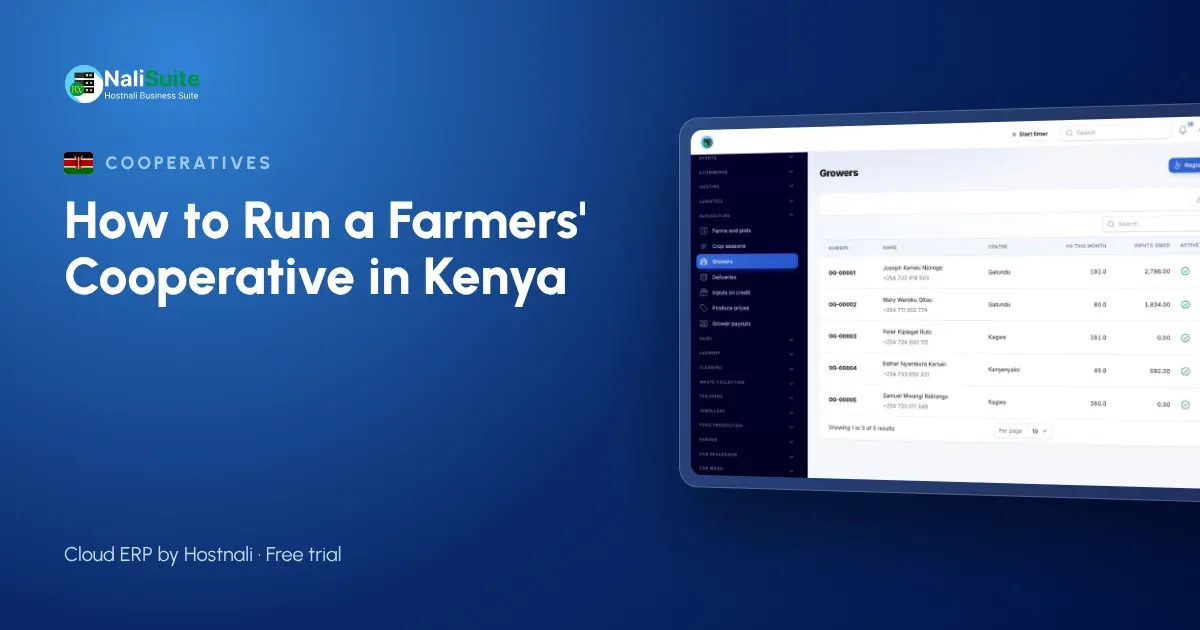
A cooperative in Kenya lives or dies by trust. Members bring milk, tea, coffee or maize to the collection point every day, and at the end of the month they want one thing: to be paid the right amount, on time, with a statement they can understand. This guide covers the routines that make that possible, from the member register to the M-Pesa payout.
Know exactly who your members are
A cooperative cannot pay people fairly if it is not sure who they are. Keep one record per member with a unique member number, phone number, the details you pay them to, the collection point they deliver to and a next-of-kin contact.
Duplicates cause most payout errors: the same farmer registered twice under slightly different spellings. Search before you add anyone new, and merge duplicates as soon as you find them.
A worked example: a dairy society near Nyeri
Picture a dairy society in Nyeri County with around 600 active members on five collection routes. Milk comes in twice a day. Clerks used to write each delivery in a book, and at month end two people spent a week adding up litres, subtracting feed bought on credit and the share contribution, and writing payout lists. Arguments were common, because a member could not see how the figure was reached. When the society moved to recording every delivery at the route centre, with a text receipt to the farmer’s phone, the month-end work shrank to checking and approving, and complaints dropped because every member could match the receipts against the statement.
Make the collection point the source of truth
The collection point is where errors either start or stop. Capture each intake as it happens, with the member number, quantity, grade and the price that applies on that day, and give the member a receipt by text.
For milk, record morning and evening intake separately and reject deliveries that fail the quality check at the door, rather than arguing about them at month end.
Credit from the cooperative store
Run the cooperative store like a shop that sells on account. Goods leave stock, the member’s account is charged, and the balance is recovered from their next payout.
Because stock and member accounts are linked, the store manager knows what is left on the shelf and the treasurer knows what members owe, without comparing two notebooks.
Paying members by M-Pesa
Most Kenyan members expect to be paid on their phone. Paying by M-Pesa saves the trip to collect cash and leaves a clear record on both sides. Before the first bulk payout, confirm each member’s registered M-Pesa number, and keep a second contact for widows, youth or members who share a phone.
If the society also runs a SACCO or savings scheme, agree in writing which deductions go to savings and which go to loan repayments, and show each one as its own line on the statement. Members who can see their savings grow are far more likely to stay loyal in the months when a private buyer offers a slightly higher price at the gate.
Deductions members can understand
Deductions are the most common cause of complaints. List them clearly: what the item is, when it was taken and how much is being recovered this period.
If a member’s deductions are larger than their earnings for the month, carry the balance forward rather than paying them nothing without explanation, and tell them before payday.
Pay members on time, every time
Fix a payout date and keep to it. On that date, the system works out each member’s earnings, takes off the agreed deductions and produces the payout list. Pay members by M-Pesa or Airtel Money, and record each payment against the member so the statement shows it.
Paying late, even by a week, pushes members to side-sell to traders who pay cash at the gate.
Statements and transparency
Send every member a statement each period: deliveries with dates and weights, the price applied, each deduction and the amount paid. Share it by text or WhatsApp, or let members log in to see it.
At the annual general meeting, show the totals: volume collected, what buyers paid, what was paid to members and what the cooperative kept. Openness is the best defence against rumours.
Putting it into practice with NaliSuite
The routine above maps directly onto NaliSuite. Deliveries, store credit and payouts for dairy groups run in the Dairy Cooperative Milk Collection add-on; crop collections, input credit and grower payouts in the Agriculture and Outgrowers add-on; savings and loans in the SACCO and Microfinance add-on.
All three share the same member records and post to the same Accounting books, and payouts go out through mobile money. The farms and cooperatives overview lists every app a cooperative typically uses.
Member records are personal data. Keep them secure, use them only to run the cooperative and follow the Data Protection Act, 2019, overseen by the Office of the Data Protection Commissioner.
Frequently asked questions
Can members receive their payout on M-Pesa?
Yes. Once each member’s number is confirmed, the monthly payout can be sent to M-Pesa or Airtel Money, and the payment is recorded against the member’s statement.
Does the cooperative still need its own accountant?
Usually, yes. Software keeps the deliveries, deductions and payouts in order, but your accountant or auditor still reviews the books and helps with KRA filings and the annual audit.
Can members get a receipt for every delivery?
Yes. Each delivery recorded at the collection point sends a text receipt to the member’s phone with the quantity and date.
What does it cost to start?
NaliSuite plans start from Ksh 250 a month, with a free trial, and the cooperative add-ons are added to any plan.
Try NaliSuite
Start a free trial, import your member list and record a week of deliveries at one collection point. You will see the first statements before month end. See the plans.