 KES
 UGX - Uganda
 TZS - Tanzania
 RWF - Rwanda
 NGN - Nigeria
 ZAR - South Africa
 USD - Zimbabwe
 GHS - Ghana
 ETB - Ethiopia
 ZMW - Zambia
 USD - International

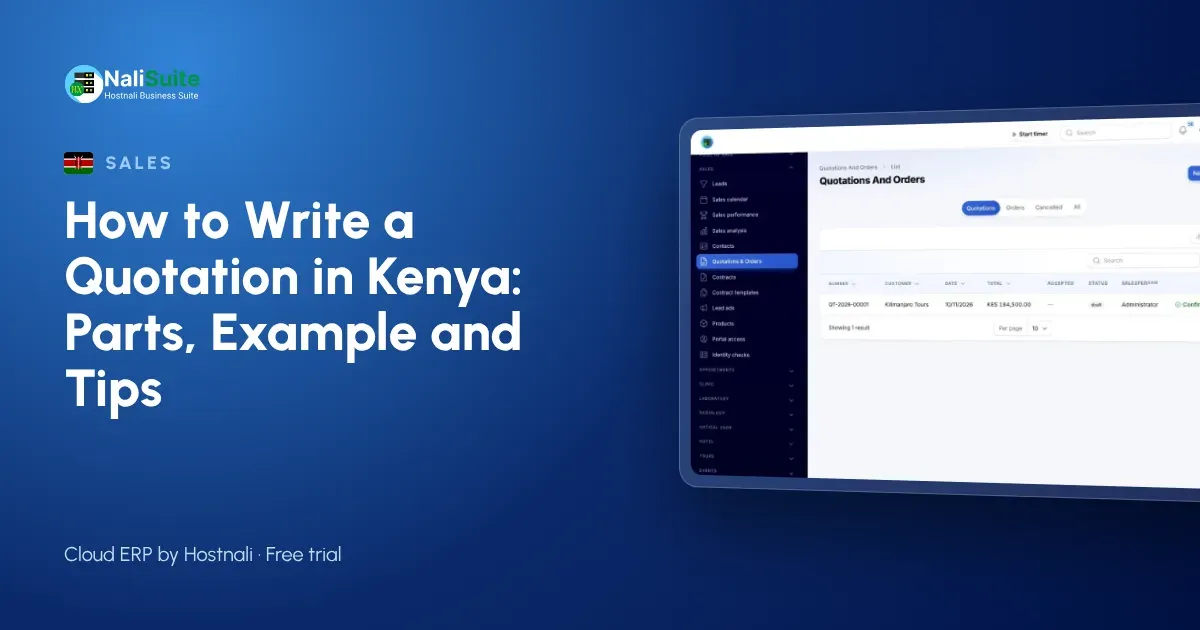
A quotation is often the first document a customer sees from your business. A clear one tells them you know your job and your prices. A vague one, sent as a WhatsApp message with a single figure, invites haggling and delays.
This guide breaks a good Kenyan quotation into its parts, shows a sample layout and ends with tips that help more quotes turn into paid work.
Quotation, estimate or proforma?
These words are used loosely in Kenya, but they mean different things:
- Quotation. A fixed offer: this work, at this price, if accepted within a set period.
- Estimate. A best guess where the final cost may change, common in repairs and construction.
- Proforma invoice. A document that looks like an invoice, sent before the sale, often so the customer can raise payment or a purchase order.
If you call something a quotation, the customer will expect you to honour the price. Use an estimate when you genuinely cannot fix it.
The parts of a good quotation
1. Your business details
Business name, physical address or town, phone, email and your KRA PIN. If you are VAT-registered, say so. A logo helps, but clear contact details matter more.
2. The customer’s details
The customer’s name, company and, for businesses, their KRA PIN if they want it on the eventual invoice. Getting this right at the quote stage saves corrections later.
3. Quote number and dates
A unique number (for example Q-2026-041), the date issued and a validity date. Thirty days is common; in a period of changing supplier prices, 7 or 14 days may be safer.
4. A description of the work
Say exactly what is included. “Supply and install 6 security lights, including cabling and labour, at the client’s premises in Kitengela” beats “lighting works”. Say what is not included too, for example “excludes trenching through concrete”.
5. Line items
Each line shows the item, quantity, unit price and line total. Group lines into sections (materials, labour, transport) on bigger jobs.
6. Taxes
If you are registered for VAT, show the VAT at 16% separately and the total including VAT. Customers who are VAT-registered want to see it clearly. If you are not registered, do not add VAT. The free VAT calculator helps when a customer asks for a VAT-inclusive figure.
7. Payment terms
When and how you want to be paid. For example: “50% deposit on acceptance, balance on completion. Pay by M-Pesa to paybill [number], account [quote number], or by bank transfer.”
8. Terms and acceptance
A few lines on timelines, warranties and what happens if the scope changes, plus a space or link for the customer to accept.
A sample layout
| Section | Example |
|---|---|
| Header | Business name, PIN, contacts, “Quotation Q-2026-041” |
| Customer | Name, company, address |
| Dates | Issued 3 November, valid until 17 November |
| Scope | Supply and install 6 security lights in Kitengela |
| Lines | Lights × 6; cable, 40 m; labour, 2 days; transport |
| Totals | Subtotal, VAT 16%, total |
| Payment | 50% deposit by M-Pesa or bank, balance on completion |
| Terms | Timeline, warranty, changes in scope |
| Acceptance | Link to accept, or signature and date |
Writing quotes faster
Many Kenyan businesses still type each quote from scratch in a word processor. That is slow and leads to errors: an old price, a wrong total, a missing VAT line.
NaliSuite Sales and Quotations fills in your products, prices and VAT, so a quote takes minutes. You can add sections, optional lines and discounts, then send it as a branded PDF by email or WhatsApp. The customer opens a link and accepts online, and you are notified straight away. Accepted quotes become sales orders and then invoices without retyping; NaliSuite Invoicing adds a link to pay by M-Pesa, Airtel Money or card, and the invoice goes through KRA eTIMS where required (see KRA eTIMS).
Tips to win more jobs
- Reply fast. A quote sent the same day often wins over a cheaper one sent a week later.
- Offer options. A basic and a better option, with optional lines, lets the customer choose rather than compare you with a competitor.
- Be specific. Customers trust detailed quotes more than round figures.
- Follow up. Call or message two or three days after sending. Many quotes are simply forgotten.
- Keep a record. Track which quotes were won and lost, and why. The CRM app keeps every deal on one board.
Common mistakes
- No validity date, so a customer comes back six months later expecting the old price.
- VAT added by a business that is not VAT-registered.
- Totals typed by hand and wrong.
- Payment details missing, so the customer cannot pay the deposit.
- Scope so vague that the customer expects more than you priced.
Frequently asked questions
Is a quotation legally binding in Kenya?
A quotation is an offer. Once the customer accepts it on the stated terms, it can form the basis of a contract. For large jobs, ask a lawyer to review your standard terms.
Should I charge for quotations?
For simple quotes, usually not. For jobs that need site visits or design work, many businesses charge a survey fee and deduct it from the final invoice if the job goes ahead.
Can I send a quotation on WhatsApp?
Yes. Send a PDF or a link to the quotation rather than a typed message, so the customer has a proper document.
How do I change a quotation after sending it?
Issue a revised version with a new number or a revision letter (Q-2026-041-B) so everyone knows which one is current.
Try NaliSuite
NaliSuite lets Kenyan businesses send quotes customers accept online, then invoice and collect by M-Pesa from the same record. Plans start at Ksh 250 a month with a free trial; see the plans or learn more about NaliSuite.