 KES
 UGX - Uganda
 TZS - Tanzania
 RWF - Rwanda
 NGN - Nigeria
 ZAR - South Africa
 USD - Zimbabwe
 GHS - Ghana
 ETB - Ethiopia
 ZMW - Zambia
 USD - International

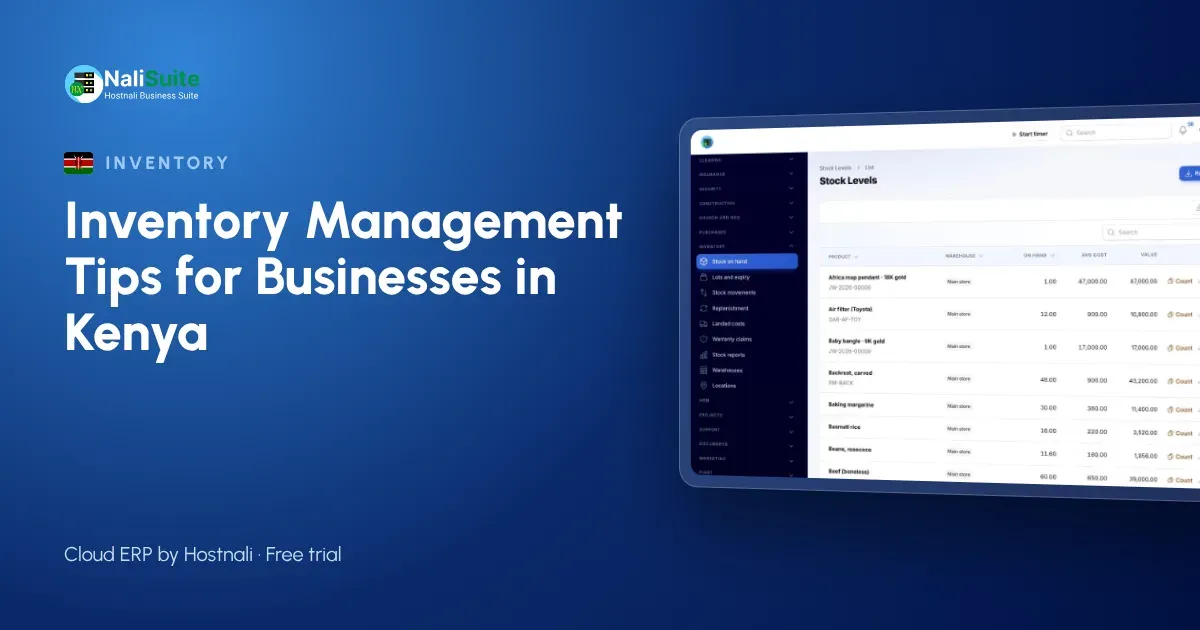
Ask a shop owner in Kenya where their money is and the honest answer is often “on the shelves”. Stock is usually the biggest thing a small business owns, and also the easiest to lose track of. These tips are for shops, distributors and chemists who want to know what they have, what is selling and what to order next.
Count your stock properly, once
Everything else depends on knowing what you have today. Pick a quiet day, count every item once, and enter the figures as your opening stock. Use barcodes where you can: a phone camera or a cheap USB scanner is faster and more accurate than writing on paper.
After that first full count, switch to cycle counting: count a different section each week, starting with fast movers and high-value items. Small, regular counts catch errors early and never close the shop.
Stock challenges Kenyan businesses face
Suppliers in Nairobi’s Industrial Area or at Gikomba may deliver on short notice, prices move with the shilling, and many businesses buy in bulk when a good deal appears. That makes overstocking easy and cash flow tight.
Chemists and agrovets have an extra job: tracking batches and expiry dates, because expired stock is both a loss and a compliance problem. Shops with M-Pesa tills also need sales and stock in the same place, or the evening count never matches.
Use reorder points, not memory
A reorder point is the stock level at which you place a new order. Work it out from how much you sell each day and how long your supplier takes to deliver, then add a small safety buffer. For example, if you sell 10 cartons a day and delivery takes 5 days, reorder when you have about 60 left.
Start with your top 50 items. Once those never run out, extend reorder points to the rest of the range.
Example: an agrovet in Nakuru
An agrovet in Nakuru sells seed, fertiliser, animal feed and veterinary products, some of which expire within months. The owner sets a reorder point for each fast-moving line and records the batch and expiry date of every delivery. Each morning a short report shows what to reorder and which batches expire in the next 60 days, so near-expiry stock goes to the front of the shelf or into a promotion.
The stock-take that used to close the shop for a day now takes a morning with a phone scanner.
Don’t let stock expire on the shelf
Pharmacies, agro-dealers, food and cosmetics businesses all sell products that expire. Record the batch (lot) number and expiry date of every delivery, sell the oldest first, and check a report of stock expiring in the next 60 or 90 days every month.
Batch tracking also helps when a supplier recalls a product: you can see in seconds whether you have that batch and where it went.
Mistakes Kenyan businesses often make
- Buying the whole deal. A supplier offers a discount on 50 cartons; you take them all and the cash sits on the shelf until March. Buy what your reorder point says, plus a sensible extra.
- Separate books for the till and the stockroom. If sales go through one system and deliveries through another, the numbers will not agree by Friday.
- Ignoring returns and breakages. A broken bottle that is never written off becomes a “missing” bottle at the next count.
- Counting only in December. By then a whole year of small errors has piled up.
Find and reduce shrinkage
Shrinkage is the gap between what your records say and what is on the shelf. Some of it is theft, but much is simple error: deliveries not checked, sales not recorded, damaged goods not written off.
Check every delivery against the purchase order before you accept it, record damaged and expired goods as write-offs, and compare counts with records weekly. When the till and stock are one system, a gap stands out quickly instead of hiding until year-end.
Getting started in Kenya
Begin with the products that matter most: your top sellers and anything expensive. Import them from a spreadsheet with buying price, selling price and barcode, then count them to set opening stock.
Next, set reorder points for those lines and connect your suppliers, so purchase orders go out from the system instead of a phone call you might forget. If you sell through an M-Pesa till, connect sales and stock in the same system so the evening count and the M-Pesa statement both match what left the shelves.
Finally, if you must issue eTIMS invoices, use a system that sends them as you sell; NaliSuite provides the eTIMS connection and you add your own KRA credentials.
Frequently asked questions
Can I track stock for an M-Pesa till and a second shop separately?
Yes. Each shop has its own stock location, and its till reduces stock there; transfers move goods between them. Payments by M-Pesa are matched to sales in the same system.
What is a reorder point?
The stock level at which you place a new order: average daily sales multiplied by the supplier’s lead time, plus a safety buffer.
Can I import my existing stock list?
Yes. Import products, prices and opening stock from Excel or CSV.
Try NaliSuite
NaliSuite inventory comes with every plan from Ksh 250 a month, together with the point of sale, purchases and accounting. Start a free trial and import your product list in minutes. See plans.