 KES
 UGX - Uganda
 TZS - Tanzania
 RWF - Rwanda
 NGN - Nigeria
 ZAR - South Africa
 USD - Zimbabwe
 GHS - Ghana
 ETB - Ethiopia
 ZMW - Zambia
 USD - International

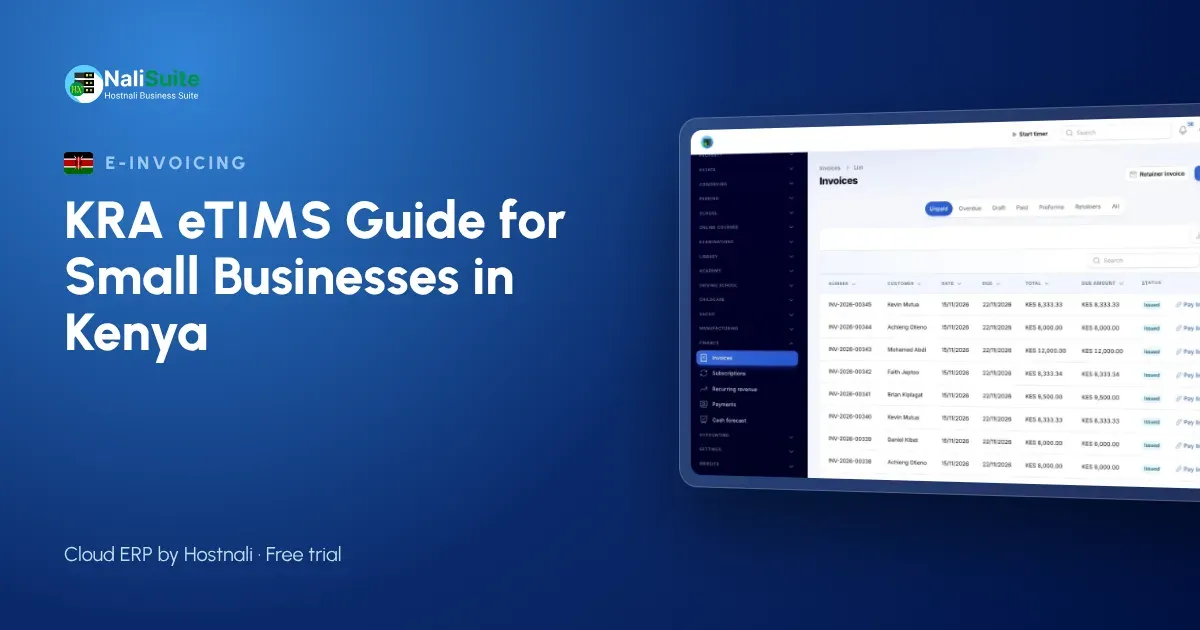
eTIMS, KRA’s electronic Tax Invoice Management System, is no longer something only big VAT-registered companies think about. Every person in business in Kenya must issue invoices through eTIMS, and from 1 January 2026 KRA checks the income and expenses in tax returns against eTIMS invoices.
This guide explains what that means for a small business in Nairobi, Mombasa, Nakuru or anywhere else in Kenya, and how to issue eTIMS invoices as part of your normal invoicing instead of typing them into a separate portal.
What eTIMS is
eTIMS is the system KRA uses to receive and validate tax invoices. When you issue an invoice through eTIMS, KRA receives its details, and the invoice your customer gets carries the details that show it was transmitted. Your customer can then use it to support their own expense claims.
Who must use eTIMS
Every person in business in Kenya must issue invoices through eTIMS, whether or not they are registered for VAT. That includes sole traders, small shops, consultants, contractors and service businesses, not just large companies.
If you sell to other businesses, they will increasingly ask for an eTIMS invoice before they pay you, because of the expense rule below.
Why your customers care: expenses need eTIMS invoices
An expense needs a valid eTIMS invoice from the supplier to be deductible, except for items KRA exempts (such as salaries). From 1 January 2026 KRA checks the income and expenses in tax returns against eTIMS invoices, withholding tax records and customs data.
In practice this works in two directions:
- When you sell, a business customer needs your eTIMS invoice to claim the cost. No eTIMS invoice can mean no deduction for them, and a slower payment for you.
- When you buy, you need eTIMS invoices from your own suppliers. Ask for them at the time of purchase; chasing them at year-end is much harder.
Getting set up
Each business registers with KRA and gets its own eTIMS credentials, which it then enters in its invoicing system. The steps look like this:
- Make sure your KRA PIN and iTax details are up to date.
- Register for eTIMS with KRA and get your credentials.
- Enter the credentials in your invoicing software, which provides the connection to eTIMS.
- Issue a test invoice and check that it carries the eTIMS details.
Keep your credentials private. Anyone with them can issue invoices in your business’s name.
Issuing eTIMS invoices day to day
The biggest time cost of eTIMS comes from doing everything twice: once in your invoicing or spreadsheet, and again on a separate portal. The better approach is to issue eTIMS invoices straight from the system you already use for quotations, invoices and payments.
In NaliSuite Invoicing, you enter your own eTIMS credentials once and NaliSuite provides the connection: each invoice is sent to eTIMS as you issue it, and the PDF your customer receives already carries the KRA details and QR code. Credit notes are linked to the original invoice. See how NaliSuite handles KRA eTIMS.
A simple eTIMS routine
| When | What to do |
|---|---|
| Every sale | Issue the invoice from your system so it goes to eTIMS straight away |
| Every purchase | Ask the supplier for an eTIMS invoice and file it with the bill |
| Weekly | Check for invoices that failed to send and fix them |
| Monthly | Compare sales in your books with your eTIMS invoices before filing returns |
Common mistakes
- Assuming eTIMS is only for VAT-registered businesses. It applies to every person in business in Kenya.
- Accepting supplier invoices without eTIMS details. The expense may not be deductible.
- Issuing invoices in one place and recording sales in another. Differences between your books and eTIMS are exactly what KRA’s checks look for.
- Sharing credentials loosely. Treat them like a bank password.
Keep your books and eTIMS in step
Because KRA compares returns with eTIMS, your accounting needs to match your invoices. When invoices, payments and the books live in one system, they do. NaliSuite’s accounting posts every invoice and payment by itself, and M-Pesa payments are matched to invoices as they arrive.
For a one-off invoice layout you can also use our free invoice generator, but for eTIMS you need a connected system.
Frequently asked questions
Do I need eTIMS if I am not registered for VAT?
Yes. Every person in business in Kenya must issue invoices through eTIMS, whether or not they are registered for VAT.
Why are customers asking me for eTIMS invoices?
Because an expense needs a valid eTIMS invoice from the supplier to be deductible, and KRA checks returns against eTIMS invoices from 1 January 2026.
Who provides the eTIMS credentials?
Each business registers with KRA and gets its own eTIMS credentials. NaliSuite provides the connection; you enter your credentials once in the invoicing settings.
Does NaliSuite file my tax returns?
No. NaliSuite sends your invoices to eTIMS and keeps your books up to date; you still file your returns with KRA.
Try NaliSuite
NaliSuite, also known as Hostnali Business Suite, brings eTIMS invoicing, M-Pesa payments, stock, payroll and accounting into one cloud ERP for businesses across Kenya. Plans start from Ksh 250 a month with a free trial; see the plans.