 KES
 UGX - Uganda
 TZS - Tanzania
 RWF - Rwanda
 NGN - Nigeria
 ZAR - South Africa
 USD - Zimbabwe
 GHS - Ghana
 ETB - Ethiopia
 ZMW - Zambia
 USD - International

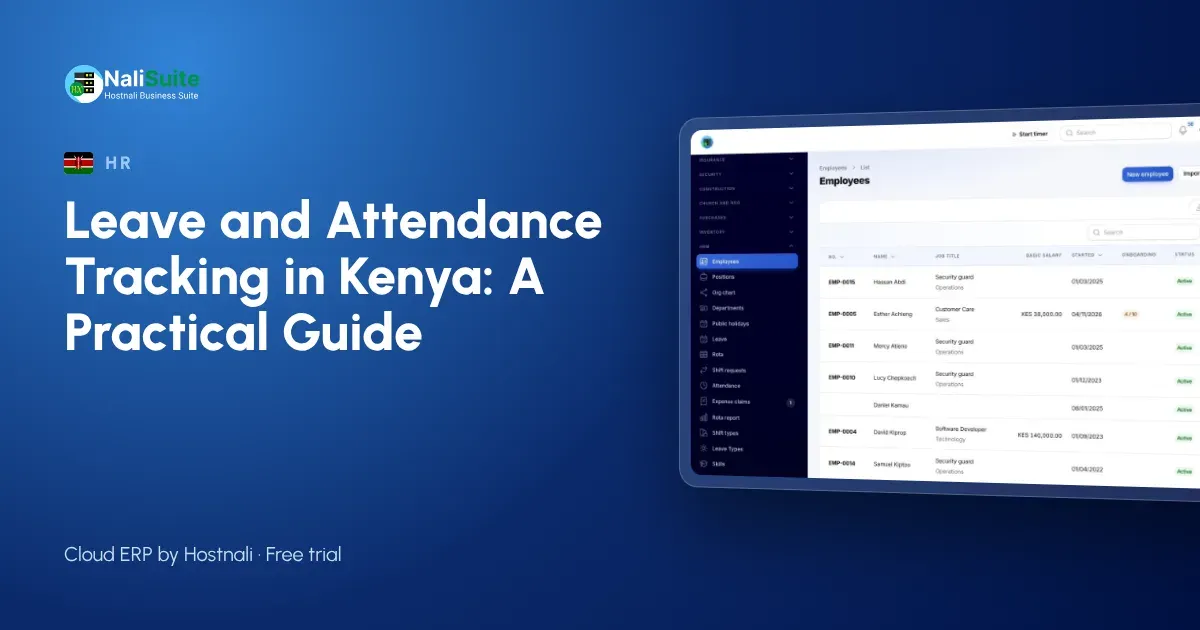
Most Kenyan businesses still run leave on a mix of WhatsApp messages, a notebook at reception and someone’s memory. It works until two people are off on the same busy Saturday, or until month-end payroll needs to know who was actually at work.
This guide explains what to track, how to set it up on staff phones and how it connects to payroll, with an example from a hardware wholesaler in Nakuru.
Questions to answer before you start
- Which leave types do your contracts in Kenya promise, and how many days each?
- Does leave build up month by month or arrive at the start of the year?
- Can unused days be carried over, and is there a limit?
- Who approves leave for each team, and who covers when they are away?
- Which sites need a geofence, and what are the working hours at each?
- Which employees are paid by the day or hour, so attendance changes their pay?
Decide the rules first
Software only enforces the rules you give it. Write down, in plain words:
- the leave types in your contracts and how many days each one gives;
- whether leave builds up monthly or is granted at the start of the year;
- who approves leave for each team;
- what counts as late, and what happens when someone is;
- how overtime is approved before it is paid.
Example from Kenya
At a hardware wholesaler in Nakuru with 18 staff, the yard supervisor kept leave in an exercise book and the owner approved requests by text. When a storekeeper disputed a deduction for two missed days, nobody could show when he had asked for leave or who had agreed to it. Moving leave requests into the employee app gave every request a date, an approver and a balance, and the argument never came up again.
How staff request leave
There is nothing to install from an app store: the employee app opens in the phone’s browser and can be added to the home screen. An employee chooses the leave type, the dates and a note; the team lead gets a notification, checks the team calendar and approves. If the request is declined, the employee sees why.
Attendance with geofencing
Geofencing means clock-in only counts when the phone is inside an area you draw around the shop, office, warehouse or client site. Employees tap to clock in when they arrive and clock out when they leave. Late arrivals are flagged against the start time you set, and team leads see who is in without walking the floor. Biometric records can be imported if you already use a fingerprint device.
Getting buy-in
Introduce the app as a benefit, not a control: no more waiting for a team lead to sign a leave form, a clear balance on the phone, and pay slips without a trip to the office. Location is captured only when someone clocks in or out.
Connecting it to pay day
The point of tracking leave and attendance is a correct payslip. NaliSuite passes leave, absences and overtime straight into Payroll, which works out PAYE, NSSF, SHIF and the Housing Levy. Employees see the same figures on their payslip that their team lead approved. You can also try the PAYE calculator for a single salary.
Leave and attendance in Kenya: what to keep in mind
In Kenya, the number of annual leave days, sick days and maternity or paternity leave comes from the Employment Act and from each contract, so set your leave types to match what you have agreed with staff and check your employment law if you are unsure. Because attendance feeds the pay run, it also shapes PAYE, NSSF, SHIF and the Housing Levy for anyone paid by the day or with overtime. Many Kenyan teams are spread between a shop in town and staff on the road, which is where phone check-in with a geofence earns its keep.
Another example: Nairobi
Take a chain of three pharmacies in Nairobi with about 24 employees. Before going digital, the team lead in Nairobi kept leave on a wall calendar and paid overtime from memory. In the first month on NaliSuite, the leave calendar showed two clashes before they happened, and overtime was paid by bank and M-Pesa or Airtel Money only for hours that had been approved.
What goes wrong, and how to prevent it
Leave tracking usually fails for straightforward reasons: balances that were never loaded, approvers who are not told about requests, and attendance records nobody reviews. Fix these with three habits: load starting balances before go-live, give every team a named approver and a backup, and look at the late and absence report every Monday.
Using the numbers
Once leave and attendance are in one place, a few reports become easy: who has the most unused leave, which site has the most late arrivals, and how much overtime each team worked against plan. Looking at them once a month is enough to stop small problems turning into payroll disputes.
How to switch from paper
Start with one team rather than the whole company. Load their leave balances, set their geofence and run both systems side by side for two weeks. When the app’s records match reality, add the next team. Most companies have everyone on it within a month.
Frequently asked questions
Can casual workers in Kenya check in on their phones?
Yes. Any staff member with a smartphone can use the employee app from the browser; casuals paid by the day get their days counted for the pay run.
Does leave affect M-Pesa salary payments?
Unpaid leave and absences reduce pay in the pay run, and the M-Pesa and bank payout files are produced from the final figures.
Do staff need a laptop?
No. The employee app works on any smartphone browser and can be added to the home screen.
Try NaliSuite
Leave, attendance, HR and payroll are part of every NaliSuite plan, from Ksh 250 a month. Start a free trial and set up your first team this week, or compare the plans.