 KES
 UGX - Uganda
 TZS - Tanzania
 RWF - Rwanda
 NGN - Nigeria
 ZAR - South Africa
 USD - Zimbabwe
 GHS - Ghana
 ETB - Ethiopia
 ZMW - Zambia
 USD - International

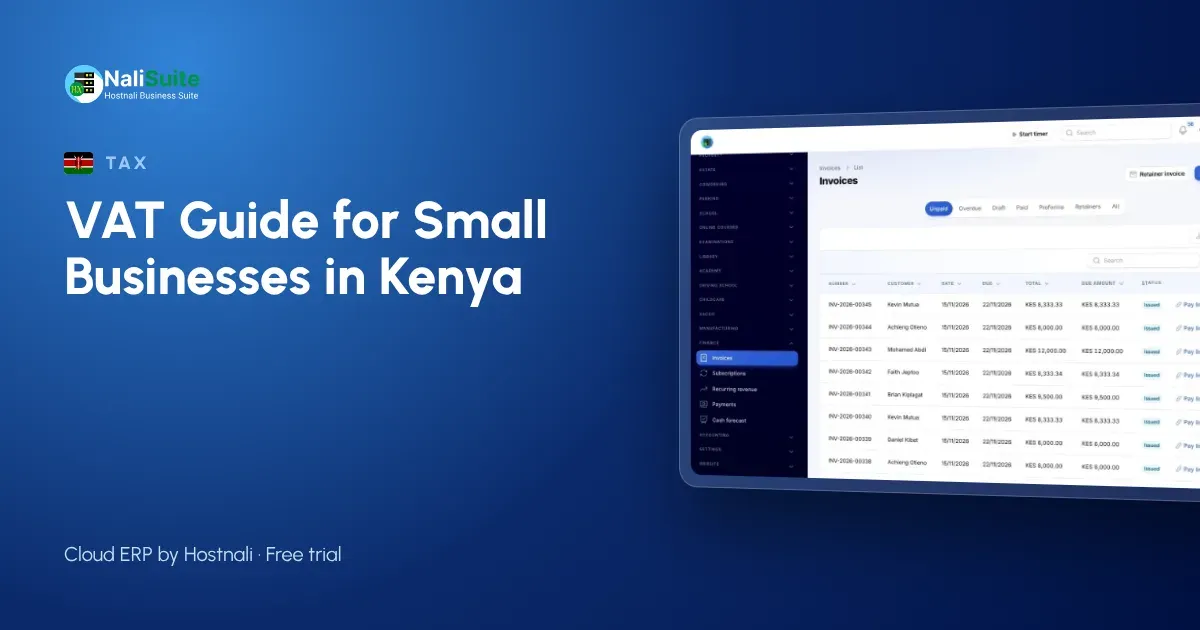
A Nairobi hardware shop and a Nakuru consultant face the same three VAT questions every month: what to charge, what to keep and what to send to the Kenya Revenue Authority. This guide answers them in the order you meet them, using Kenya’s standard rate of 16%.
Start with the price, not the tax
Decide first whether the figures on your price list already include VAT. Shops that sell to the public usually show VAT-inclusive prices, because customers compare the amount they will pay. Suppliers selling to other businesses often quote before VAT, because their customers claim the VAT back.
Mixing the two is the most common source of small losses. If your shelf price of KES 1,160 is meant to include VAT but you record it as a net price, you declare KES 185.60 of VAT instead of KES 160, and the difference comes out of your margin on every sale.
Adding 16% to a net price
Multiply the net price by 1.16. A KES 25,000 consulting fee becomes KES 29,000, of which KES 4,000 is output VAT.
Taking 16% out of a total
Divide the total by 1.16. A customer who paid KES 11,600 has paid KES 10,000 for the goods and KES 1,600 in VAT. The free VAT calculator does both directions if you’d rather not do the sums.
Every sale needs an eTIMS invoice
In Kenya, invoices go through KRA’s eTIMS. The invoice your customer receives carries the KRA details, and KRA compares the sales and purchases in your return with what eTIMS has recorded. Your suppliers’ eTIMS invoices are also what make your own expenses count, so ask for them every time you buy.
NaliSuite provides the eTIMS connection: you register with KRA, get your own credentials and enter them once. After that, every invoice from NaliSuite Invoicing is sent as you issue it. The eTIMS feature page explains the setup.
Input VAT: the part people forget to claim
The VAT you pay on stock, rent, fuel and services can usually be set off against the VAT you collect. You can only do that if the purchase is backed by a valid invoice with the supplier’s KRA PIN on it, so file supplier invoices as they arrive instead of hunting for them at month end.
Filing on iTax
The return brings together your sales, your purchases and the difference you owe or carry forward. With invoices and bills already in NaliSuite Accounting, the VAT report gives you the figures to enter; you still file and pay on iTax yourself. Check filing dates and any changes with KRA, because they are the authority on deadlines.
A short monthly routine
- Match M-Pesa and bank receipts to invoices so no sale is missing.
- Check that every supplier bill has an eTIMS invoice.
- Run the VAT report and compare it with last month.
- File on iTax and record the payment.
A month in the life of a small VAT-registered firm
Take a sample Mombasa printing shop. In October it sells business cards, banners and branded T-shirts to around sixty customers, most of whom pay by M-Pesa. It buys paper, ink and blank shirts from three suppliers in Nairobi and pays rent for its workshop.
At the end of the month the owner wants three numbers: VAT charged on sales, VAT paid on purchases and the difference. If each sale went out as an eTIMS invoice and each supplier sent one back, those numbers already exist. The owner’s job is to look for gaps: a banner job paid in cash with no invoice, or an ink delivery with only a delivery note. Fixing those before filing is far cheaper than explaining them later.
Keeping VAT separate from your spending money
Because VAT arrives inside your takings, it is easy to treat it as income. A simple discipline helps: each week, move the VAT portion of your receipts into a separate account or M-Pesa wallet you don’t spend from. When the return is due, the money is waiting.
Second example: a mixed basket at an Eldoret shop
A sample agrovet in Eldoret sells animal feed, farm tools and veterinary products in one sale. If some of those items are treated differently for VAT, one receipt can carry two tax treatments. Setting the tax on each product, rather than on the whole sale, is what keeps the receipt right: the tools carry 16%, and items KRA treats differently carry their own treatment.
Frequently asked questions
What is the VAT rate in Kenya?
The standard rate used in this guide is 16%. Some goods are zero-rated or exempt, so confirm the treatment of what you sell with KRA or your accountant.
Do I need eTIMS if my customers are individuals?
KRA requires eTIMS invoicing for businesses generally, not only for sales to companies. Check your own position on the KRA website.
Can M-Pesa payments be matched to VAT invoices?
Yes. In NaliSuite, payments made through an invoice’s pay link close that invoice automatically, so the VAT on it is already linked to the payment.
Should I register for VAT voluntarily?
That depends on your customers and costs. Talk to your accountant or KRA before deciding.
Try NaliSuite
NaliSuite works out 16% per line, sends eTIMS invoices and prepares your VAT figures, from Ksh 250 a month. See the plans.