 KES
 UGX - Uganda
 TZS - Tanzania
 RWF - Rwanda
 NGN - Nigeria
 ZAR - South Africa
 USD - Zimbabwe
 GHS - Ghana
 ETB - Ethiopia
 ZMW - Zambia
 USD - International

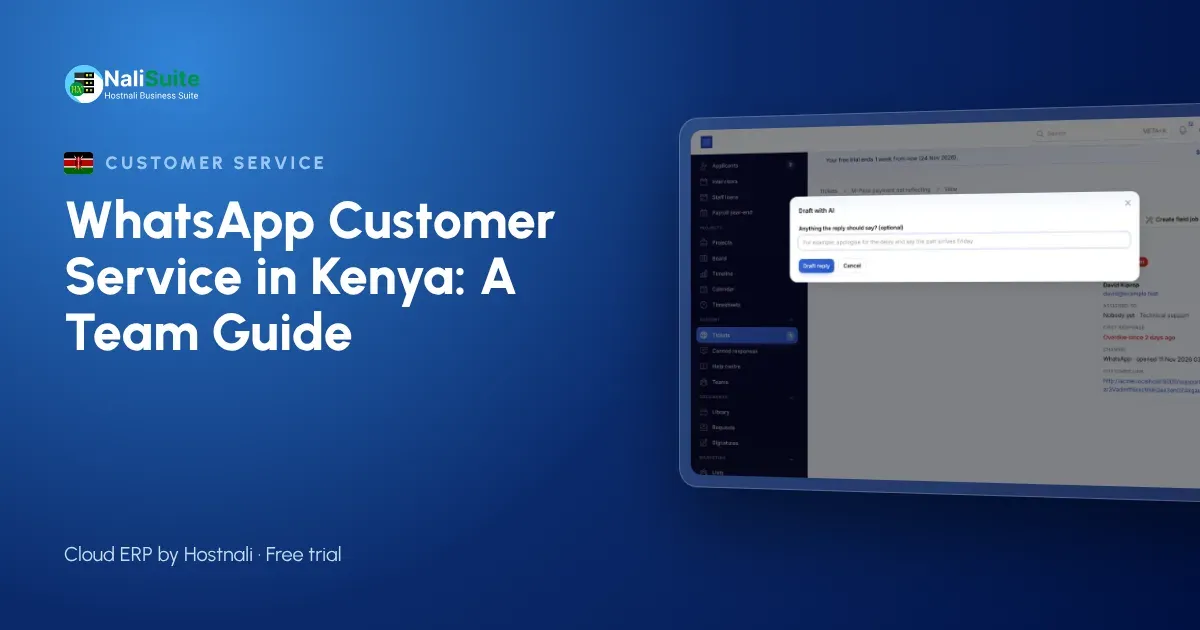
In Kenya, customers rarely fill in a contact form. They send a WhatsApp message, often at 9pm, and expect a reply before they move on to the next shop. That habit is good news for sales and hard work for staff, especially when three people reply from three different phones.
Why WhatsApp needs a team, not a phone
A single phone on the counter in Nairobi has three problems. Only the person holding it can reply. The history leaves with that person when they change jobs. And there is no way to see which customers are still waiting. None of that matters at ten messages a day. At fifty, it costs sales.
Picture an electronics shop on Moi Avenue in Nairobi with two branches and one WhatsApp number printed on every receipt. On a Saturday the number gets around 80 messages: price checks, delivery questions, “is the TV still in stock?” and photos of M-Pesa confirmations. The owner’s phone holds the whole conversation history, so when the owner is at the supplier in Industrial Area, nobody else can answer.
Step 1: put one business number in front of everyone
Use a single business number for sales and support, and connect it to the WhatsApp Business Cloud API so messages arrive in a shared inbox instead of one handset. In NaliSuite Helpdesk each message becomes a ticket that anyone on the team can open, whether they are in the Mombasa branch or working from home.
Step 2: treat every conversation as a ticket
A ticket has an owner, a status and a history. When a customer in Nakuru asks about a delivery, the ticket is assigned to whoever handles deliveries, and it stays open until the question is answered.
- Assign each new chat to a person or team, automatically or by hand.
- Tag it: price question, order, complaint, payment.
- Close it only when the customer has what they needed.
Step 3: agree how fast you reply
Set a simple promise, such as a first reply within 15 minutes during opening hours and by 9am the next day for evening messages. Service levels in the helpdesk show which chats are close to breaking that promise, so a manager in Nairobi can step in before the customer gives up.
Step 4: save quick replies for everyday questions
Opening hours, delivery areas around Eldoret, how to pay and return rules are asked again and again. Saved replies let any staff member answer them correctly in seconds, and AI drafts can suggest an answer from your own help articles for the team to check and send.
Send quotes, invoices and receipts inside the chat
The fastest way to close a sale on WhatsApp is to send the document in the same thread. A quotation from Sales can be accepted online, an invoice from Invoicing carries a pay link for M-Pesa, card or bank transfer, and the till can send the receipt by WhatsApp. See how it fits together on the WhatsApp feature page.
Broadcast only to customers who said yes
Promotions work on WhatsApp, but only for customers who opted in. Use approved message templates from Marketing, send them to your opted-in list and make it easy to stop. Customers in Kenya quickly block numbers that spam them.
Mistakes that cost replies
- Answering from personal numbers. The customer saves the staff member’s number, and when that person leaves, so does the relationship. Keep every chat on the business number.
- No owner for evening messages. Messages that arrive after closing in Nairobi should be assigned to someone for the first hour of the next day, not left for whoever opens WhatsApp first.
- Prices typed from memory. A price quoted in a chat should come from the same price list the till uses, or two customers in Mombasa will compare notes.
- Screenshots as proof of payment. Confirm M-Pesa and bank payments from your own records, not a picture, and let the invoice mark itself paid.
- Broadcasting to everyone. Promotions sent to people who never opted in get your number blocked or reported.
A day in a shared inbox
At 8am the overnight chats are already assigned: two orders for the Nairobi shop, a delivery question for dispatch, a complaint for the manager. By 9am each has a first reply. At midday a customer in Nakuru accepts a quotation online and pays the invoice from the same chat; the helpdesk shows it closed. In the afternoon a new staff member answers a returns question with a saved reply and gets it right first time. At closing, the open-ticket count is zero and nobody had to hand over a phone.
WhatsApp service in Kenya: what to keep in mind
Kenyan customers increasingly expect to finish the whole sale inside the chat. Sending the invoice with an M-Pesa pay link in the same thread, and a receipt as soon as the payment lands, removes the step where a customer forwards a confirmation SMS and someone checks it by hand. Remember that every invoice still has to follow your KRA rules; NaliSuite can also connect to KRA eTIMS with your own credentials.
Kenyan shoppers also use WhatsApp to compare. A customer in Mombasa may message three phone shops with the same question and buy from whoever answers first with a clear price and an M-Pesa link. Speed and clarity win more often than the lowest price. If your shop also sells through Jumia or Instagram, route those enquiries to the same inbox so one person does not handle three channels on three devices.
Frequently asked questions
Can my M-Pesa till and WhatsApp work together?
Yes. Invoices sent on WhatsApp carry a pay link where the customer can pay by M-Pesa, card or bank transfer, and the invoice is marked paid when the money arrives in your own account.
Can I keep using my existing business number?
In most cases yes, once it is moved to the WhatsApp Business Cloud API. Messages then reach NaliSuite instead of a single phone, and your team answers from there.
Do I need the WhatsApp Business API?
Yes, to share one number across a team you connect it through the official WhatsApp Business Cloud API. Our team can help a Kenyan business set it up.
Can several staff answer at the same time?
Yes. Messages arrive as tickets in the helpdesk, so several people can answer different customers from one number, each with the full history.
Try NaliSuite
NaliSuite brings WhatsApp, helpdesk, sales, invoicing and mobile money into one cloud ERP, from Ksh 250 a month. Start a free trial from the plans page and connect your business number.