
Recommended Services


Supported Scripts

A web hosting company provides the server infrastructure needed to make your website accessible online.
Your website consists of files, databases, images, applications and other resources. These need to be stored on a server connected to the internet.
When someone enters your domain name, such as:
yourbusiness.co.ke
their browser connects to the server hosting your website and retrieves the necessary information.
Your hosting company therefore plays an important role in keeping your website available to visitors.
Why Choosing the Right Hosting Company Matters
Not all hosting companies provide the same level of service.
Two hosting plans may appear similar because they both advertise:
- 20 GB storage
- SSL
- WordPress
- Unlimited bandwidth
But the actual experience can be very different.
The underlying server technology, resource allocation, security, support and infrastructure can have a major impact on your website.
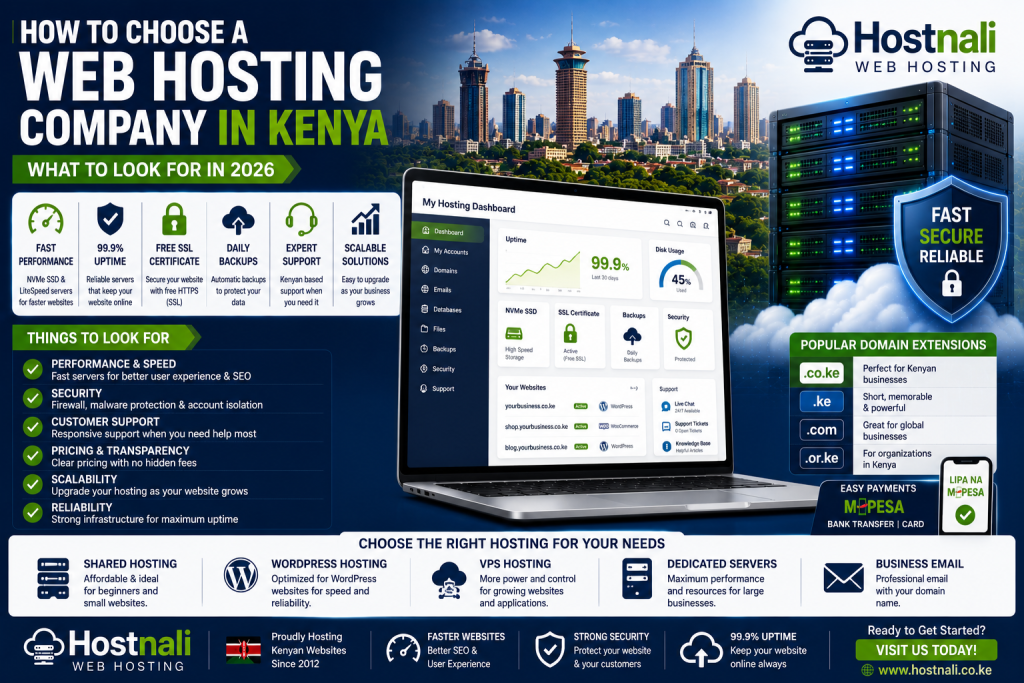
10 Things to Look for in a Kenyan Hosting Company
1. Reliable Uptime
Your website needs to be available when customers visit it.
Look for hosting providers that publish clear uptime commitments and have reliable infrastructure.
Downtime can result in:
- Lost customers
- Missed enquiries
- Lost sales
- Poor user experience
- Damage to your online reputation
Don’t choose a hosting company based only on the word “unlimited.”
Ask how the provider manages reliability and server availability.
2. Fast Server Performance
Website speed matters for both visitors and businesses.
A slow website can frustrate visitors and negatively affect conversions.
When comparing hosting companies, look for modern technologies such as:
- NVMe SSD storage
- LiteSpeed Web Server
- Efficient caching
- Optimised server configurations
- Adequate CPU and RAM resources
For WordPress websites, hosting performance can be particularly important because themes, plugins, databases and images can all affect loading times.
3. Free SSL Certificate
A modern website should use HTTPS.
When choosing a hosting company, check whether SSL is included in your hosting package.
SSL helps encrypt communication between your website and visitors.
Look for:
- Free SSL
- Automatic installation
- Automatic renewal
- HTTPS support
You shouldn’t necessarily have to purchase a separate SSL certificate just to secure an ordinary business website.
4. Regular Backups
Imagine spending months building your website and then losing important data because of:
- Accidental deletion
- Malware
- Plugin problems
- Server problems
- Human error
That’s why backups are essential.
Ask your hosting provider:
How often are websites backed up?
Also ask:
- How long are backups retained?
- Can I restore my website myself?
- Are backups stored separately?
- Is backup restoration included in support?
A hosting company offering backups can provide an important safety net.
5. Good Customer Support
Even experienced website owners sometimes need technical support.
You may encounter:
- DNS problems
- Email delivery issues
- SSL errors
- Database errors
- WordPress problems
- Domain configuration problems
- Server issues
A responsive support team can save you hours of troubleshooting.
For Kenyan businesses, local or Kenya-focused support can also be convenient because you can communicate with a team familiar with the local market.
6. Multiple Hosting Options
Your website may grow.
You might start with shared hosting and eventually require VPS or dedicated hosting.
Therefore, choose a company that offers a clear upgrade path.
A typical progression might be:
Shared Hosting → VPS → Dedicated Server
This allows you to scale without having to completely change hosting providers when your requirements increase.
7. cPanel or Another Reliable Control Panel
A hosting control panel makes it easier to manage your website.
With cPanel, you can typically manage:
- Domains
- Email accounts
- Databases
- Files
- SSL
- Backups
- DNS
- Applications
For beginners, a familiar control panel can make website management considerably easier.
8. Business Email
Professional email is important for businesses.
Instead of:
you can use:
This creates a more professional appearance when communicating with customers.
When choosing hosting, check whether business email accounts are included.
Also consider:
- Mailbox storage
- Spam protection
- Webmail
- IMAP/SMTP support
- Email security
9. Security Features
Your hosting company should take server security seriously.
Look for features such as:
- Malware scanning
- Firewall protection
- Account isolation
- Secure server configurations
- Regular updates
- Brute-force protection
- Backups
- SSL certificates
However, remember that hosting security is only one part of website security.
You should also:
- Use strong passwords
- Update WordPress
- Update plugins
- Use trusted themes
- Enable two-factor authentication
- Limit administrator access
10. Transparent Pricing
Don’t look only at the introductory price.
Ask:
How much will I pay when the promotion ends?
Compare:
- Initial price
- Renewal price
- Domain price
- SSL cost
- Email cost
- Backup cost
- Migration charges
- Upgrade costs
A slightly more expensive hosting plan may actually provide better value if it includes important features that another provider charges for separately.
Types of Hosting You Should Consider
The best hosting plan depends on your website.
Shared Hosting
Shared hosting is suitable for:
- Small business websites
- Blogs
- Portfolio websites
- New websites
- Low-to-medium traffic websites
It’s generally the easiest place for beginners to start.
WordPress Hosting
WordPress hosting is designed specifically for WordPress websites.
It can be suitable for:
- Business websites
- Blogs
- Online stores
- Professional websites
Look for WordPress-friendly infrastructure and support.
VPS Hosting
VPS hosting provides more resources and control than traditional shared hosting.
It can be suitable for:
- Growing businesses
- Higher-traffic websites
- Web applications
- Ecommerce websites
- Websites outgrowing shared hosting
Dedicated Servers
Dedicated hosting provides an entire physical server for one customer.
It can be suitable for:
- Large ecommerce businesses
- High-traffic websites
- Large applications
- Organisations requiring significant resources
- Businesses needing extensive server control
How Much Should You Pay for Hosting in Kenya?
There isn’t one correct price for web hosting.
The cost depends on:
- Hosting type
- Storage
- CPU resources
- RAM
- Bandwidth
- Number of websites
- Email accounts
- Backups
- Security features
- Support
- Server infrastructure
Instead of asking:
“What’s the cheapest hosting?”
ask:
“What hosting gives me the features and performance I need at a reasonable total cost?”
Should You Choose a Kenyan Hosting Company?
A Kenyan hosting provider can offer several advantages.
Local Payment Options
Many Kenyan customers prefer convenient payment methods such as M-Pesa.
Local Support
A Kenya-focused provider may understand the requirements of local businesses.
Kenyan Domain Support
You can conveniently manage domains such as .co.ke.
Local Market Knowledge
A provider serving Kenyan businesses may understand the needs of:
- SMEs
- Ecommerce businesses
- Schools
- NGOs
- Developers
- Startups
However, don’t choose a provider solely because it is local. Compare the actual infrastructure, features, support and reliability.
Why Hostnali?
Hostnali provides web hosting services for Kenyan businesses, organisations, developers and website owners.
Its hosting ecosystem includes solutions ranging from standard hosting to VPS and dedicated servers.
When choosing Hostnali or any other hosting provider, evaluate the package according to your own requirements.
Important factors include:
- Server performance
- Storage technology
- SSL
- Backups
- Security
- Technical support
- Scalability
- Pricing
The right hosting plan should provide enough resources for your current website while giving you room to grow.
Questions to Ask Before Buying Hosting
Before paying for a hosting plan, ask the provider:
Is SSL included?
Are backups included?
How often are backups performed?
What happens when my website outgrows the plan?
Can I upgrade easily?
Is technical support available?
Does the plan include business email?
What control panel is provided?
What is the renewal price?
Can I migrate my existing website?
Are there additional setup or migration fees?
These questions can help you avoid unpleasant surprises later.
A Simple Hosting Comparison Checklist
| Feature | What to Look For |
|---|---|
| Performance | NVMe SSD, LiteSpeed, adequate resources |
| Uptime | Reliable infrastructure |
| SSL | Free SSL and automatic renewal |
| Backups | Regular backups and easy restoration |
| Security | Malware protection and server security |
| Support | Responsive technical assistance |
| Control Panel | cPanel or another easy-to-use panel |
| Professional business email | |
| Scalability | VPS and dedicated upgrade options |
| Pricing | Transparent renewal costs |
Common Mistakes When Choosing Hosting
Choosing Only Based on Price
The cheapest plan isn’t necessarily the best value.
Ignoring Renewal Prices
Always check what you’ll pay after the introductory period.
Buying More Resources Than You Need
A new website doesn’t necessarily require a powerful VPS or dedicated server.
Choosing a Provider Without Support
Technical problems can happen at any time.
Ignoring Backups
A cheap hosting plan isn’t worth much if you lose your website and have no way to restore it.
Forgetting Scalability
Your hosting requirements can change as your business grows.
Frequently Asked Questions
Which web hosting company is best in Kenya?
The best provider depends on your website’s requirements. Compare performance, uptime, security, support, pricing and scalability before making a decision.
What is the best hosting for a small business in Kenya?
Shared or business hosting is usually a suitable starting point for a small website. You can upgrade as traffic and resource requirements increase.
Is local web hosting better?
Not automatically. A local provider can offer convenient support and payment options, but you should still compare infrastructure, reliability, security and pricing.
Does hosting affect website speed?
Yes. Server hardware, storage technology, server configuration, caching and available resources can all affect website performance.
Should I choose cPanel hosting?
cPanel can be a convenient choice for website owners because it provides an interface for managing domains, email, files, databases and other hosting functions.
When should I upgrade from shared hosting?
Consider upgrading when your website consistently reaches resource limits, experiences performance problems, or requires software and resources that shared hosting cannot provide.
Final Thoughts
Choosing a web hosting company in Kenya should be about more than finding the lowest monthly price.
Look at the complete hosting package:
Performance + uptime + security + support + backups + scalability + price.
For a new website, shared hosting may be enough. As your website grows, you may eventually need WordPress hosting, VPS hosting or a dedicated server.
The most important thing is to choose a provider that can support you throughout that growth.
If you’re looking for hosting for your Kenyan website, explore Hostnali Web Hosting and compare the available solutions.