 KES
 UGX - Uganda
 TZS - Tanzania
 RWF - Rwanda
 NGN - Nigeria
 ZAR - South Africa
 USD - Zimbabwe
 GHS - Ghana
 ETB - Ethiopia
 ZMW - Zambia
 USD - International

Wanjiru runs an electrical supplies shop in Nakuru. For three years her books lived in one Excel file that her nephew built: a tab for sales, a tab for purchases and a summary that turned green when the month made money. Then she opened a second shop in Naivasha, KRA started matching returns against eTIMS invoices, and the green summary stopped meaning anything.
If that story sounds close to home, this article is for you. It looks at what a spreadsheet really costs a Kenyan business, where accounting software earns its place and how to change over without losing years of records.
The hidden cost of “free” Excel
Excel feels free because you already paid for it. The real cost is time and doubt.
Every M-Pesa confirmation has to be typed or pasted next to the right customer. Every supplier bill sits in a folder until someone finds the energy to enter it. At the end of the month the owner, or a part-time bookkeeper, spends two or three evenings ticking off paybill entries against invoices, and still finishes with a “difference” row that nobody can explain.
Doubt is the bigger cost. When the file shows a profit and the bank balance disagrees, decisions about stock, staff and pricing end up resting on instinct.
Why KRA changes the maths
For years a Kenyan business could keep rough books and tidy them up for the accountant once a year. That window is closing.
From 1 January 2026 KRA compares the income and expenses in your returns with eTIMS invoices, withholding tax records and customs data. An expense without a valid eTIMS invoice from the supplier may not be allowed, apart from items KRA exempts, such as salaries. A spreadsheet has no idea which of your purchases came with an eTIMS invoice. Accounting software can keep the supplier’s invoice attached to the bill, so the evidence is there when the return is prepared.
On the sales side, NaliSuite provides the connection to KRA eTIMS: you register with KRA, enter your own credentials once, and invoices are sent as you issue them.
What changes when the books move into software
| Daily job | In Excel | In accounting software |
|---|---|---|
| Recording a sale | Typed on the invoice, then again in the sheet | Posted to the ledger when the invoice is issued |
| M-Pesa and bank money | Pasted from statements and matched by eye | Imported and matched with suggestions |
| Supplier bills | Kept in a folder, entered later | Entered once, against the purchase it belongs to |
| VAT at 16% | A formula you hope is right | Worked out per line on every invoice |
| Month-end | Several evenings | A short review |
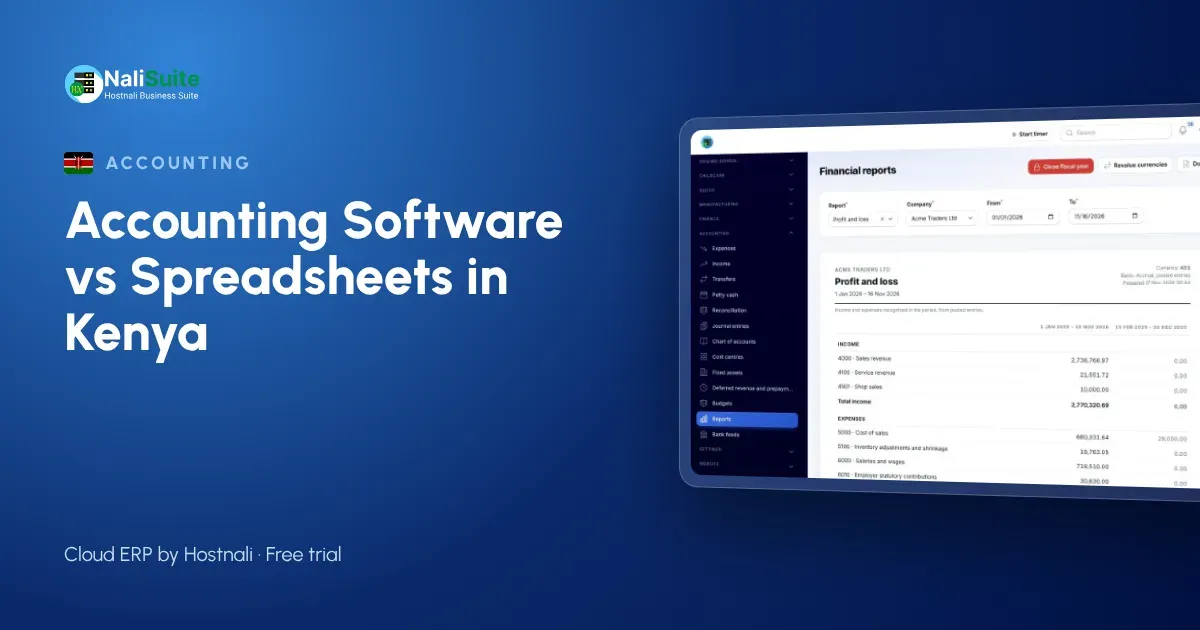
The NaliSuite Accounting app is built on double entry, so every invoice, bill, payment and payslip lands in the right account without a second round of typing.
Matching the money
Bank and M-Pesa reconciliation is usually where Kenyan owners feel the difference first. Statements are imported, each line is matched to the invoice or bill it belongs to, and the few that do not match are the only ones you look at.
Getting paid
Invoices can carry a pay link, so customers settle by M-Pesa, Airtel Money, card or bank transfer and the invoice marks itself paid.
A changeover plan for a busy owner
You do not need to stop trading to move.
- Pick a start date, ideally the first day of a month or a new financial year.
- Export your lists: customers, suppliers, products and opening balances from Excel.
- Import them, then enter unpaid invoices and bills as at the start date.
- Run Excel and the software side by side for one month and compare the totals.
- Stop updating the spreadsheet once the two agree, and keep it as an archive.
If you are coming from QuickBooks or another package rather than Excel, the switching guide covers the extra steps.
A second example: the Mombasa clearing office
A small clearing and forwarding office near Mombasa port handles around forty shipments a month. Each shipment produces a client invoice, several supplier bills (port charges, transport, handling) and payments in and out by bank and M-Pesa. In Excel, the office manager spent the first four working days of every month pairing bills with the shipments they belonged to, because the workbook had no way to link them.
After moving to software, every supplier bill is entered against its shipment as it arrives, client invoices are raised from the same file, and the month closes with only the unmatched lines left to check. The time saved is real, but the bigger gain is that each client’s profit is visible shipment by shipment.
Kenyan mistakes to avoid when you switch
- Leaving eTIMS for later. If your sales invoices must go through eTIMS, set up the connection before the first invoice in the new system, not after month one.
- Forgetting withholding tax. Customers who withhold tax will pay you less than the invoice. Record the certificates so the difference does not sit as an unpaid balance.
- Skipping the parallel month. One month in both systems catches import errors before they reach a VAT return.
Frequently asked questions
Is Excel acceptable to KRA?
KRA cares about the evidence behind your figures, not the tool you use. The difficulty with Excel is that it does not keep that evidence linked to each entry, which makes eTIMS matching hard.
How long does it take to switch?
A small shop can move its lists and balances in a day or two. Running both systems for a month is the safe way to confirm the numbers.
Can my accountant still help me?
Yes. Your accountant can be able to review and close the books with you in NaliSuite, instead of receiving a workbook by email.
Will I lose my old records?
No. Keep the spreadsheet as a read-only archive and bring only the balances and open items into the new books.
Can I see how a figure was arrived at?
Yes. Ledger entries are posted from the invoice, bill or payment that created them, so you can open the document behind a figure.
Try NaliSuite
Wanjiru’s two shops now run from one set of books. If you want the same, NaliSuite plans start from Ksh 250 a month with a free trial, and every plan includes accounting, invoicing and payroll. See the plans.