 KES
 UGX - Uganda
 TZS - Tanzania
 RWF - Rwanda
 NGN - Nigeria
 ZAR - South Africa
 USD - Zimbabwe
 GHS - Ghana
 ETB - Ethiopia
 ZMW - Zambia
 USD - International

Plenty of profitable Kenyan businesses run out of cash. A contractor in Nyeri can win a big job, buy materials up front, pay casuals every week and still wait sixty days for the client to pay. On paper the job makes money; in the M-Pesa account there is nothing left for rent. Cash flow is about timing, and timing can be managed.
1. Know your cash position every Monday
Write down three numbers each week: cash in the bank and M-Pesa today, what customers owe you and what you owe suppliers. If you only look at the bank balance, you will be surprised by bills you forgot and comforted by payments that are not coming.
2. Take deposits on big jobs
For custom work, large orders and events, ask for part payment before you start. A deposit covers your materials and proves the client is serious. Record it against the invoice so the balance stays visible.
3. Shorten the time to get paid
Invoice the day you deliver, not at month end. Put an M-Pesa pay link on every invoice so paying takes one tap, and send a polite reminder the day after the due date. Our guide on reconciling M-Pesa payments explains how to keep track of what came in.
4. Agree supplier terms that match your customers’
If customers pay you in 30 days, try to pay suppliers in 30 days too. Ask long-standing suppliers for terms; many will agree once you have a record of paying on time.
5. Watch stock like cash
Stock on the shelf is money you cannot spend. Reorder fast-moving items often and in smaller quantities, and stop buying lines that sit for months. NaliSuite Inventory shows what moves and what does not.
6. Turn regular work into regular income
Maintenance contracts, monthly retainers and memberships smooth out the lumpy months. Subscriptions invoices them automatically every period.
7. Keep tax money separate
VAT collected and PAYE deducted belong to KRA, not to you. Move them to a separate account when you receive them so they are there when the returns are due.
A simple 13-week forecast
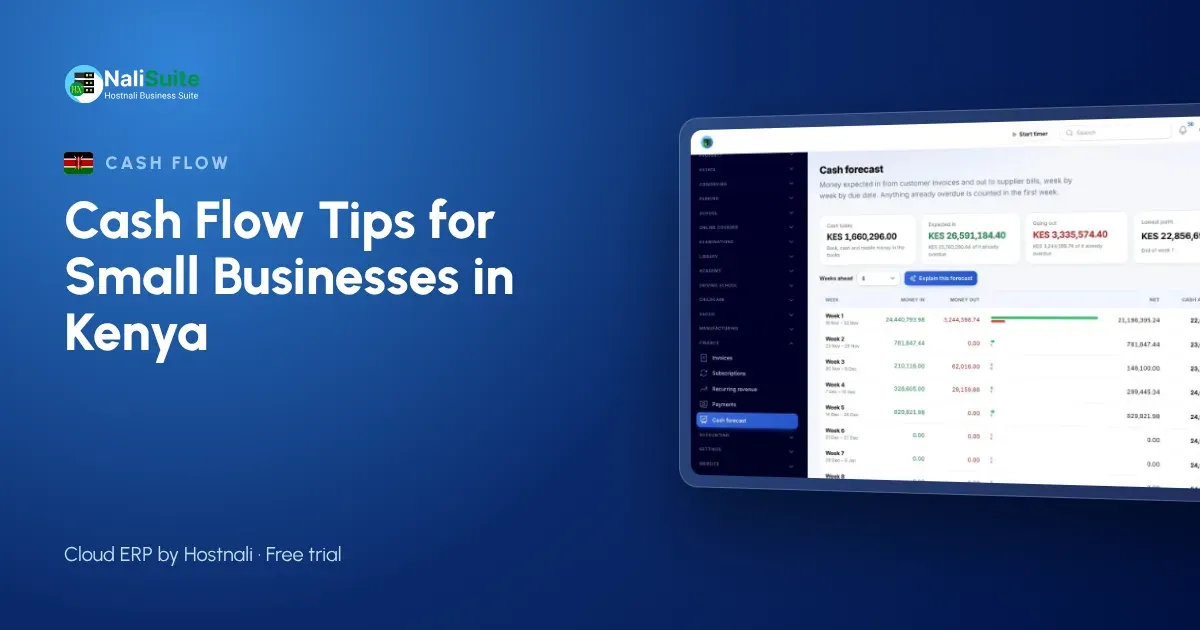
List expected receipts and payments week by week for the next quarter: customer payments you are confident of, salaries, rent, supplier bills and tax. The week where the balance dips lowest is the week to plan for now, by chasing a debtor, delaying a purchase or arranging short-term finance before you need it.
A Nyeri contractor turns it around
Back to the contractor from the start. After one tight quarter, the business changed three things: a 40% deposit on every job, invoices sent from site on completion with an M-Pesa pay link, and a Monday review of debtors. Materials were now paid for by the client’s deposit, final payments came in days instead of weeks, and the Monday review caught slow payers early. The work and margins did not change; the cash in the account did.
A second example: a Mombasa hardware shop
A hardware shop near Mombasa’s Kongowea market sells to walk-in buyers by M-Pesa and to fundis on credit. Its cash used to vanish in the long rains, when building slowed but stock orders did not. The owner now looks at last year’s sales by month before ordering, cuts orders for slow months by a quarter, and caps credit per fundi at what each has repaid on time before. The shop still has quiet months, but it no longer borrows to get through them.
Cash flow mistakes Kenyan owners make
- Mixing business and personal M-Pesa. Use a separate till or paybill for the business.
- Spending VAT before it is due. It feels like your money until the KRA return arrives.
- Paying suppliers early by habit. Pay on the due date unless there is a discount.
- Giving credit without a limit. Set a limit per customer and stick to it.
- No forecast. Even a rough 13-week list beats guessing.
Your first month: four actions
- Open a separate business till or paybill if you do not already have one, and move all business receipts there.
- List every customer who owes you money and when each invoice was due. Call the three oldest this week.
- Write next quarter’s 13-week forecast and mark the tightest week.
- Agree a deposit policy for large jobs and add it to your quotation template.
Frequently asked questions
What is the difference between profit and cash flow?
Profit is what you earn on paper; cash flow is when the money actually arrives and leaves. A profitable business can still run short of cash if customers pay late.
How much cash should a small business keep?
Many owners aim for at least one month of fixed costs in reserve. Your forecast will show what is realistic for you.
Does software really help?
Yes, because it shows unpaid invoices, upcoming bills and stock in one place, and sends reminders for you.
Should I use a separate M-Pesa line for the business?
Yes. A business paybill or till keeps business money visible and makes reconciliation much easier.
When should I review my cash flow forecast?
Every Monday, updating it with what actually came in and went out the week before.
Try NaliSuite
NaliSuite brings invoicing, payments, stock and accounting together from Ksh 250 a month. See the plans.