 KES
 UGX - Uganda
 TZS - Tanzania
 RWF - Rwanda
 NGN - Nigeria
 ZAR - South Africa
 USD - Zimbabwe
 GHS - Ghana
 ETB - Ethiopia
 ZMW - Zambia
 USD - International

Most small businesses in Kenya run without a written budget. Money comes in through M-Pesa, the till and the bank, bills go out, and the owner checks the balance and hopes it is enough. That works until a slow month, a big order that needs stock upfront, or a tax payment arrives at the wrong time.
A budget is simply a plan for the next twelve months: what you expect to earn, what you expect to spend, and what should be left. Here is how to build one in six steps.
Step 1: Gather last year’s numbers
The best guide to next year is the year just gone. Pull together:
- sales by month from your till, invoices and M-Pesa statements,
- what you paid suppliers each month,
- rent, wages, utilities and other regular bills,
- one-off costs such as equipment, repairs and licences.
If your records are scattered, spend an afternoon putting them in one place. Even rough monthly totals are better than none. If you are a new business, use your plan, quotes from suppliers and conversations with people in the same trade.
Step 2: Estimate sales month by month
Do not just take last year’s total and add 10%. Look at the pattern. Many Kenyan businesses have clear seasons:
- school-fee months in January, May and September, when household spending shifts,
- the December holiday rush for retail and hospitality,
- harvest seasons for agribusiness and farm suppliers,
- quieter periods after big spending months.
Write a sales figure for each month, and be honest. It is safer to plan on slightly lower sales and be pleasantly surprised.
Step 3: List your costs and split them
Sort every cost into one of two groups:
| Type | What it means | Examples |
|---|---|---|
| Fixed | Paid whatever your sales are | Rent, salaries, internet, insurance, software |
| Variable | Rises and falls with sales | Stock, packaging, delivery, sales commission, payment charges |
Fixed costs tell you the minimum you need to earn each month just to stay open. Variable costs are usually best planned as a share of sales, for example stock at 60% of sales.
Step 4: Plan for tax and payroll
Two items catch Kenyan businesses out more than any others: tax and statutory payroll deductions.
- If you are VAT-registered, the standard rate is 16%. VAT you collect is not yours, so set it aside rather than counting it as income.
- If you have staff, PAYE, NSSF, SHIF and the Affordable Housing Levy are due every month. The PAYE calculator helps you estimate the deductions and employer contributions for each salary.
- Income tax and instalment tax need their own line too. Check the current rules and dates with KRA.
Put each of these in the budget in the month it is actually paid.
Step 5: Build in a cash buffer
Things go wrong: a customer pays late, a machine breaks, sales dip. A buffer is money you plan to keep aside rather than spend. Many owners aim for enough to cover one to three months of fixed costs, built up gradually. Add a monthly “transfer to reserve” line and treat it like a bill.
Step 6: Compare actuals with the budget every month
A budget is only useful if you look at it again. At the end of each month, put your actual figures next to the plan:
- Which costs went over? Was it a one-off or a trend?
- Did sales come in above or below plan? Why?
- Do you need to adjust the next few months?
This monthly check is where budgets earn their keep. It turns a surprise at the end of the year into a decision in March.
A simple example
A sample salon in Mombasa plans a typical month. Using plain example numbers:
- Expected sales: 300,000.
- Products and supplies (25% of sales): 75,000.
- Rent: 45,000.
- Staff wages: 110,000, plus statutory contributions planned on their own line.
- Power, water and internet: 15,000.
- Transfer to reserve: 10,000.
That leaves a planned surplus before tax of about 45,000 in an average month. In December, the owner plans higher sales and more stock; in February, lower sales, and no new equipment until March.
Let your system do the comparing
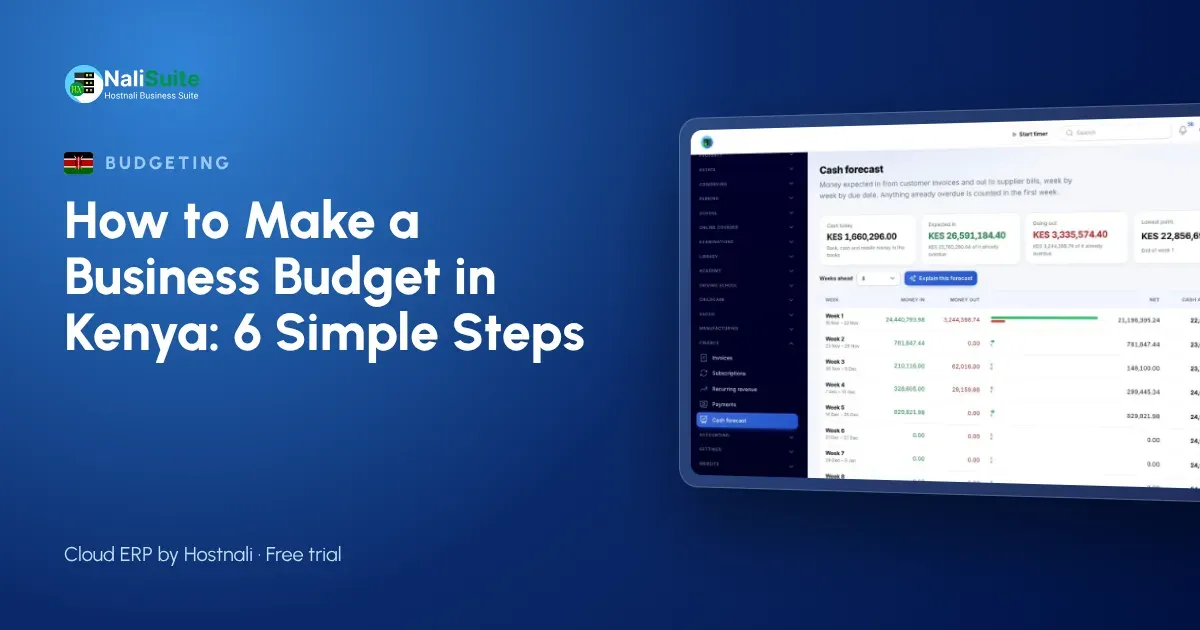
Budgets built in a spreadsheet are often abandoned by April because updating them is tedious. In NaliSuite accounting, you can set budgets by account, department or project and compare actuals to budget at any time. Because invoices, bills, M-Pesa payments and payroll post themselves to the books, the “actual” column is always current. Bank and M-Pesa reconciliation keeps those figures trustworthy.
Frequently asked questions
Do I need an accountant to make a budget?
No. You can build a useful budget yourself from your sales and costs. An accountant can help check it and plan for tax.
How detailed should my budget be?
Detailed enough to show your main cost lines and the months they fall in. Ten to twenty lines is plenty for most small businesses.
What if my sales are very unpredictable?
Plan two versions: a cautious one and a likely one. Keep fixed costs within what the cautious version can carry.
Try NaliSuite
NaliSuite keeps budgets, books, payroll and payments together, so you always know how the month is going against the plan. Plans start at Ksh 250 a month with a free trial. See the plans.