 KES
 UGX - Uganda
 TZS - Tanzania
 RWF - Rwanda
 NGN - Nigeria
 ZAR - South Africa
 USD - Zimbabwe
 GHS - Ghana
 ETB - Ethiopia
 ZMW - Zambia
 USD - International

A hardware dealer in Nakuru or a hotel in Mombasa can lose more money through careless buying than through slow sales. When anyone can order from any supplier, bills arrive that nobody remembers approving, stock goes missing between the lorry and the store, and the same invoice gets paid twice.
A simple purchase order process fixes most of this. This guide walks through it step by step for businesses in Kenya, including what eTIMS means for the supplier invoices you keep.
Why buying needs a process
The owner of a growing business cannot approve every order by phone forever. A purchase order process lets you hand buying to your team while still knowing exactly what was ordered, received and paid.
The purchase order process, step by step
1. Start with a request
Nothing is ordered until it has been asked for in writing. The request says what is needed, how much and what it is for.
2. Check and approve
Someone with authority checks that the purchase is needed and affordable, then approves it within their limit.
3. Send a numbered PO
The supplier receives a PO with a number, the agreed prices and delivery details. That number appears on everything that follows.
4. Check the delivery
At delivery, the goods are counted and inspected against the PO. Anything short, wrong or damaged is noted on the spot.
5. Match, then pay
The bill is checked against the PO and what was received. Matched bills are paid on their due date and recorded.
Three-way matching
Before any bill is paid, compare it with two other documents. Accountants call this three-way matching:
| Document | What it tells you |
|---|---|
| Purchase order | What you agreed to buy, and at what price |
| Goods received note | What actually arrived, and in what condition |
| Supplier bill | What the supplier is asking you to pay |
Software can do the comparison for you and flag only the bills that disagree, so your accounts person spends time on exceptions, not on every line.
Example: a hardware wholesaler in Nakuru
Take an example hardware wholesaler in Nakuru that buys cement, roofing sheets and paint from five regular suppliers. Before it had a process, the branch manager phoned orders through, the driver collected goods, and bills turned up weeks later. Twice in one quarter it paid for roofing sheets that had come back damaged.
With purchase orders, the manager raises a request for 200 bags of cement, the owner approves it on their phone, and the PO goes to the supplier by email or WhatsApp. When the lorry arrives, the storekeeper counts the bags against the PO and records what was actually received. The supplier’s bill is matched to both before anyone pays it by M-Pesa or bank transfer.
eTIMS and supplier invoices in Kenya
Since KRA moved to eTIMS, the supplier’s invoice matters more than ever. An expense generally needs a valid eTIMS invoice from the supplier to be deductible, except for items KRA exempts, such as salaries. From 1 January 2026, KRA also checks the expenses in tax returns against eTIMS invoices.
That makes receiving the supplier’s eTIMS invoice part of the purchase process, not an afterthought. Ask for it with every delivery, check the supplier’s KRA PIN on it, and attach it to the bill in your system. Read more about eTIMS in NaliSuite.
Common mistakes to avoid
- Approving after the fact. If orders go out first and get approved later, the approval is just paperwork.
- Not recording partial deliveries. If half the order arrives, record half. Otherwise the bill for the full order looks correct.
- Paying from statements. Pay matched bills, not supplier statements, so nothing is paid twice.
- No limits. Without approval limits, every request waits for the owner and the process gets skipped.
Paying suppliers on time in Kenya
Late payment damages supplier relationships, and in Kenya many suppliers give better prices and credit to customers who pay when they say they will. Once bills are matched, list them by due date and plan payments weekly.
M-Pesa paybill and till payments are fast for smaller suppliers; bank transfers suit larger bills. Whichever you use, record the M-Pesa or bank reference against the bill. When you reconcile your M-Pesa and bank statements at month end, every supplier payment then has a matching bill and PO behind it. See how bank and M-Pesa reconciliation works.
A few habits help: ask regular suppliers for a monthly statement and compare it with your open bills, agree payment terms in writing on the PO, and give one person the job of approving supplier payments.
Doing it in software
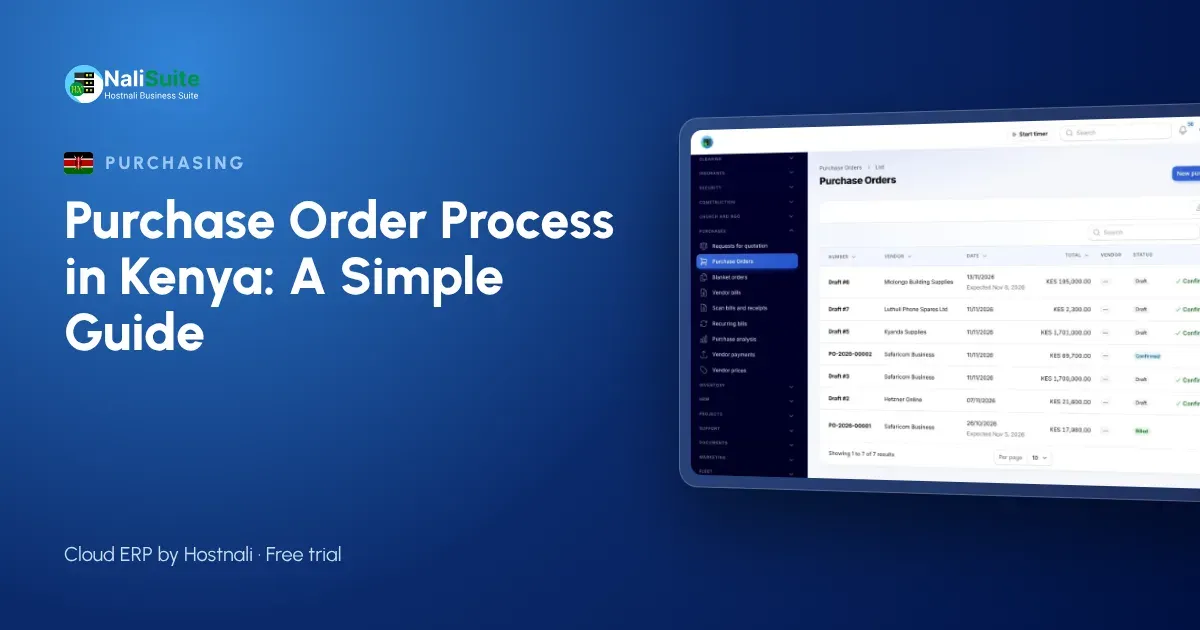
A system keeps every step connected. In NaliSuite, a request becomes a PO, a delivery updates stock, and the supplier bill lands in accounting already matched. The Purchases app shows what is ordered, received and owed at any moment.
Frequently asked questions
Do I need an eTIMS invoice for every purchase?
For an expense to be deductible, KRA generally expects a valid eTIMS invoice from the supplier, with exceptions such as salaries. Ask suppliers for one with every delivery and keep it with the bill.
Can I pay suppliers by M-Pesa?
Yes. Many suppliers in Kenya accept M-Pesa paybill or till payments as well as bank transfers. Record the payment against the matched bill so your books stay right.
What is a goods received note?
A record of what actually arrived from the supplier, including any short or damaged items. It is one of the three documents you match before paying.
How long does it take to set up?
A small business can set up suppliers, approval limits and its first purchase orders in a day.
Try NaliSuite
NaliSuite runs purchases, inventory and accounting in one cloud ERP, with plans from Ksh 250 a month and a free trial. See plans and prices.