
Recommended Services


Supported Scripts

If you have ever visited a website and noticed HTTPS and a padlock in the browser address bar, that website is using a TLS certificate. Many people still call these certificates SSL certificates, even though modern websites use TLS rather than the older SSL protocol.
For Kenyan businesses, choosing the right SSL certificate is an important part of website security. Whether you operate a small business website, WordPress blog, online shop, school portal, NGO website, company website or web application, your website should use HTTPS.
But there are different types of SSL/TLS certificates. You may have heard of DV, OV, EV, Wildcard and Multi-Domain certificates and wondered which one your website actually needs.
The good news is that most website owners do not need the most expensive certificate.
For many websites, a properly configured Domain Validated (DV) TLS certificate is enough.
This guide explains the main SSL certificate types and helps you choose the right option for your website in Kenya in 2026.
What Is an SSL Certificate?
An SSL certificate is a digital certificate that helps establish an encrypted connection between a visitor’s browser and your website.
Technically, modern certificates are used with TLS (Transport Layer Security), which replaced SSL as the current security protocol. However, the term “SSL certificate” remains widely used when people talk about website security.
When HTTPS is correctly configured, information transmitted between the visitor and your website can be protected from being easily intercepted.
This is particularly important when visitors:
- Log into an account
- Submit contact forms
- Create accounts
- Enter personal information
- Make payments
- Use an online store
- Access private dashboards
- Submit documents or other sensitive information
An SSL/TLS certificate can also help a website establish its identity and domain control, depending on the type of certificate and validation performed by the Certificate Authority.
Why Does Your Website Need HTTPS?
HTTPS should be standard for modern websites.
Without HTTPS, browsers may display security warnings, and visitors may be less comfortable submitting information through your website.
Google also recommends HTTPS for website and user security, and Google systems generally prefer HTTPS versions of equivalent URLs when selecting canonical URLs.
For a Kenyan business, HTTPS can therefore contribute to:
- Better website security
- Customer confidence
- Safer login forms
- Safer contact forms
- Secure ecommerce connections
- Protection of information in transit
- A more professional website experience
- Better technical website setup
However, an SSL certificate does not make your entire website secure by itself. You still need strong passwords, software updates, backups, malware protection and secure website administration.
Main SSL Certificate Types
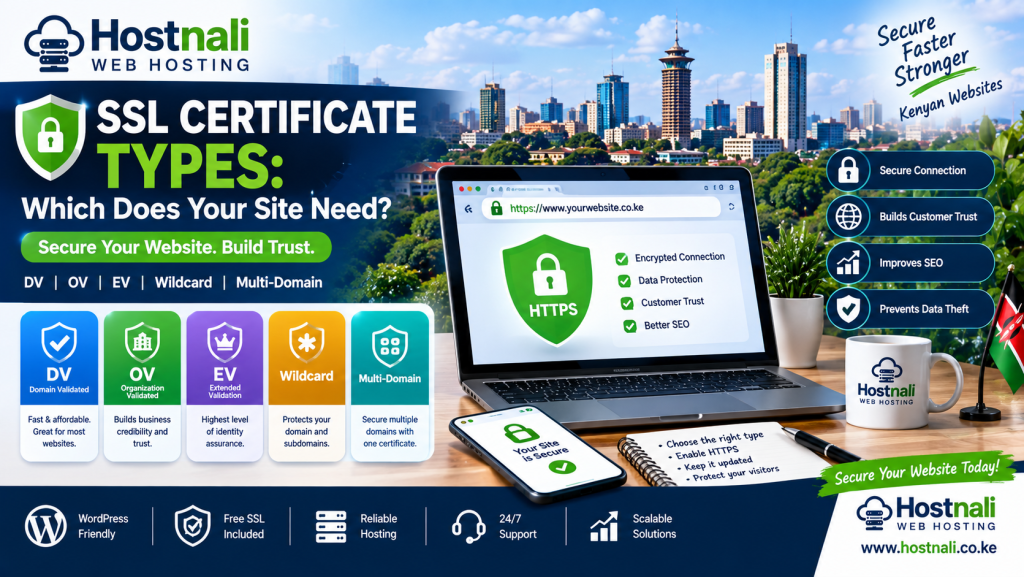
The most common SSL/TLS certificate categories are:
- DV – Domain Validated
- OV – Organization Validated
- EV – Extended Validation
- Wildcard SSL
- Multi-Domain/SAN certificates
The important thing to understand is that DV, OV and EV mainly describe how the certificate applicant is validated, while Wildcard and Multi-Domain describe what names the certificate can cover.
1. DV SSL Certificate – Domain Validated
A Domain Validated (DV) certificate is the simplest and most common type of publicly trusted website certificate.
The Certificate Authority verifies control over the domain before issuing the certificate.
For example, if you own:
example.co.ke
the Certificate Authority may verify that you control the domain before issuing the certificate.
DV certificates are suitable for:
- Personal websites
- Blogs
- Portfolios
- Small business websites
- Company websites
- WordPress websites
- Landing pages
- Information websites
- Small online stores
For many Kenyan website owners, DV is the most practical choice.
Advantages of DV SSL
- Usually inexpensive or free
- Fast issuance
- Easy to automate
- Suitable for most ordinary websites
- Provides HTTPS encryption
- Works with modern browsers
Free automated certificate authorities such as Let’s Encrypt provide TLS certificates without charging a certificate fee.
Who should choose DV?
If you run a normal business website such as:
mybusiness.co.ke
and you mainly need HTTPS encryption for your website, a properly configured DV certificate will usually be sufficient.
2. OV SSL Certificate – Organization Validated
Organization Validated (OV) certificates involve additional checks of the organization behind the domain.
The Certificate Authority verifies the domain and performs additional organization validation.
OV certificates may be appropriate for organizations that want stronger business identity validation associated with their certificate.
OV SSL can be suitable for:
- Established businesses
- Corporate websites
- Financial organizations
- Organizations with customer login areas
- Larger businesses
- Websites where organizational identity is important
The important point is that OV does not mean the website has stronger encryption simply because it is OV.
A properly configured DV and OV certificate can both provide TLS encryption.
The major difference is the validation and identity assurance process.
3. EV SSL Certificate – Extended Validation
Extended Validation (EV) certificates involve more extensive validation of the organization.
The Certificate Authority performs additional checks before issuing the certificate.
EV certificates may be considered by organizations where additional identity assurance is important.
However, there is a common misconception about EV certificates.
EV does not mean “maximum encryption”
An EV certificate does not automatically encrypt your website better than a DV certificate.
The key distinction is the level of identity validation performed by the Certificate Authority.
Modern browsers also no longer provide the old, highly visible “green address bar” treatment that historically made EV certificates stand out.
Therefore, businesses should not purchase EV simply because they believe it will automatically make their website rank higher or make their connection dramatically more encrypted.
4. Wildcard SSL Certificate
A Wildcard SSL certificate is designed to secure a domain and multiple first-level subdomains.
For example:
example.co.ke
A wildcard certificate for:
*.example.co.ke
can cover subdomains such as:
- www.example.co.ke
- shop.example.co.ke
- blog.example.co.ke
- mail.example.co.ke
The exact coverage depends on the certificate configuration. A wildcard generally covers first-level subdomains and does not automatically cover deeper levels such as:
store.shop.example.co.ke
unless the certificate specifically includes that name through another mechanism.
Who needs a Wildcard SSL?
Wildcard SSL is useful when your website uses several subdomains.
For example, a business might have:
- www.example.co.ke
- shop.example.co.ke
- app.example.co.ke
- portal.example.co.ke
Instead of managing separate certificates for every first-level subdomain, a wildcard certificate can simplify certificate management.
5. Multi-Domain SSL Certificate
A Multi-Domain certificate, sometimes called a SAN certificate, can protect multiple domain names or hostnames under one certificate.
For example, a company could potentially use one certificate for:
- example.co.ke
- example.com
- example.co.ke
- shop.example.com
The exact number and configuration depend on the certificate product.
Multi-Domain certificates are useful for:
- Businesses operating several domains
- Companies with multiple brands
- Organizations managing several related websites
- Businesses migrating or consolidating websites
- Enterprises with multiple web properties
If you only own one website, you probably do not need a Multi-Domain certificate.
SSL Certificate Types Compared
| Certificate Type | Main Purpose | Best For | Typical Complexity |
|---|---|---|---|
| DV | Domain validation | Blogs, WordPress, SMEs, normal websites | Low |
| OV | Organization validation | Established businesses and organizations | Medium |
| EV | Extended organization validation | Organizations needing additional identity assurance | Higher |
| Wildcard | One domain + first-level subdomains | Businesses using many subdomains | Medium |
| Multi-Domain/SAN | Multiple hostnames/domains | Organizations managing several domains | Medium/High |
Remember that Wildcard and Multi-Domain are not necessarily alternatives to DV, OV or EV. A certificate can combine these characteristics depending on the certificate product.
Which SSL Certificate Does a Small Kenyan Business Need?
For most small Kenyan businesses, the answer is simple:
Start with a standard DV TLS certificate.
For example, if you own a website such as:
mybusiness.co.ke
and it contains:
- Home
- About
- Services
- Contact
- Blog
- Contact forms
you probably do not need an expensive EV certificate.
A properly installed DV certificate can provide HTTPS for the website.
Your bigger priorities should be:
- Correct HTTPS configuration
- Automatic renewal
- Secure hosting
- Regular backups
- Strong administrator passwords
- WordPress updates
- Malware protection
- Secure payment processing
- Reliable hosting
What SSL Certificate Does a WordPress Website Need?
Most WordPress websites can use a standard DV certificate.
This includes:
- Business websites
- Blogs
- Personal portfolios
- NGO websites
- School websites
- Service websites
- Company websites
- Small ecommerce websites
If your WordPress installation is hosted with a provider that includes free SSL, you may not need to purchase a separate certificate.
For example, Hostnali currently includes free SSL certificates with its hosting packages.
The important thing is to ensure the certificate is actually installed, valid and configured correctly.
What SSL Certificate Does an Ecommerce Website Need?
An ecommerce website needs HTTPS because customers may:
- Log into accounts
- Submit personal information
- Add products to carts
- Enter checkout information
- Use payment gateways
- Submit delivery information
For most ecommerce websites, a properly configured DV certificate can provide the necessary TLS protection for the website connection.
You do not automatically need EV simply because you operate an online store.
However, ecommerce businesses should remember that SSL is only one part of security.
You should also consider:
- Secure payment gateways
- WordPress security
- WooCommerce updates
- Strong administrator passwords
- Secure hosting
- Malware scanning
- Backups
- Access control
- Data protection
- Fraud prevention
Do You Need Wildcard SSL for Your Website?
Ask yourself how many subdomains you use.
For example:
shop.example.co.ke
portal.example.co.ke
app.example.co.ke
If you have many first-level subdomains, Wildcard SSL may make certificate management easier.
If you only operate:
you probably don’t need a wildcard certificate.
Is Free SSL Safe?
Yes, a free SSL/TLS certificate can be perfectly suitable for many websites.
The important issue is not simply whether the certificate costs money.
What matters is whether it is:
- Issued by a trusted Certificate Authority
- Correctly installed
- Valid
- Renewed on time
- Configured correctly
- Used with HTTPS across the website
Let’s Encrypt, for example, provides free automated TLS certificates.
Many hosting companies also include free SSL as part of their hosting plans.
The certificate being free does not automatically mean it is insecure.
Free SSL vs Paid SSL
A common question from Kenyan website owners is:
“Should I pay for SSL or use free SSL?”
For many websites, free SSL is enough.
Free SSL may be suitable for:
- Blogs
- Small businesses
- WordPress websites
- Portfolios
- Informational websites
- Small ecommerce websites
- Personal websites
Paid certificates may be useful when you need:
- Specific organization validation
- Enterprise certificate management
- Specialized support
- Certain business assurance features
- Specific certificate configurations
- Multi-domain or wildcard products from a particular provider
Do not buy a certificate simply because you think a paid certificate automatically provides better encryption.
Does SSL Improve SEO?
HTTPS is important for modern SEO and website quality, but SSL is not a magic ranking solution.
Google recommends HTTPS for security, and Google systems generally prefer HTTPS versions of equivalent URLs when selecting canonical URLs.
However, installing an SSL certificate will not automatically move a website from page 20 to page 1.
Your website still needs:
- Useful content
- Good keyword targeting
- Technical SEO
- Fast loading speed
- Mobile usability
- Quality backlinks
- Good internal linking
- Search-friendly URLs
- Strong user experience
Think of HTTPS as an important part of your website’s technical foundation rather than a shortcut to rankings.
SSL Does Not Protect You From Everything
One of the biggest misunderstandings about SSL is that it makes a website completely secure.
It does not.
SSL/TLS primarily protects data while it is being transmitted between the browser and server.
Your website can still be compromised because of:
- Outdated WordPress
- Vulnerable plugins
- Weak passwords
- Stolen administrator accounts
- Malware
- Poor server configuration
- Insecure themes
- Compromised hosting accounts
- SQL injection vulnerabilities
- Poor access control
For example, a website can have a perfectly valid HTTPS certificate and still contain malicious code.
That is why website security needs several layers.
SSL Certificate Expiration
Every SSL/TLS certificate has a validity period.
Website owners must make sure certificates are renewed before they expire.
If a certificate expires, visitors may receive a browser security warning instead of seeing the normal secure HTTPS connection.
Certificate automation is therefore extremely important.
In 2026, public TLS certificate validity periods are becoming shorter. DigiCert reports that the maximum validity period for public TLS certificates became 199 days from February 24, 2026, with further reductions scheduled in future years.
This makes automated certificate issuance and renewal increasingly important for website owners.
How to Check if Your Website Has SSL
You can quickly check your website.
Step 1: Open your website
Type your domain into your browser.
For example:
Step 2: Check the address
Your website should use:
HTTPS://
rather than:
HTTP://
Step 3: Check the browser security information
Click the browser’s security/site information icon to inspect the connection.
Step 4: Check different versions of your website
Test:
Ideally, your website should consistently redirect visitors to your preferred HTTPS version.
Common SSL Problems
Even after installing SSL, you may encounter problems.
1. Mixed Content
Your website loads through HTTPS, but some images, scripts or resources still load through HTTP.
This can create mixed-content warnings.
Solution
Update the affected URLs to HTTPS and check WordPress settings, themes and plugins.
2. Certificate Expired
The certificate has passed its validity period.
Solution
Renew or reinstall the certificate and enable automatic renewal where possible.
3. Wrong Domain
The certificate does not cover the domain being accessed.
For example, the certificate may cover:
example.co.ke
but the configuration for another hostname may be missing.
Solution
Check the certificate’s covered domain names and server configuration.
4. HTTPS Redirect Problems
The website may continuously redirect visitors between HTTP and HTTPS.
Solution
Check:
- WordPress URL settings
.htaccess- Server redirects
- CDN settings
- SSL plugins
- Reverse proxy configuration
5. SSL Works but the Website Shows Errors
Sometimes SSL itself is working correctly, but another configuration is causing the problem.
Check:
- DNS
- Hosting configuration
- CDN settings
- WordPress URL
- Server redirects
- Firewall rules
How to Choose an SSL Certificate in Kenya
Before buying an SSL certificate, ask these questions.
1. How many domains do I need to protect?
One domain may only require a standard certificate.
Several domains may require Multi-Domain/SAN.
2. Do I use multiple subdomains?
If yes, consider Wildcard SSL.
3. Do I need organization validation?
If your organization requires additional identity validation, OV or EV may be appropriate.
4. Does my hosting provider already provide SSL?
Many hosting companies include SSL at no additional certificate cost.
5. Can the certificate renew automatically?
Automatic renewal reduces the risk of unexpected expiration.
6. Does my website use HTTPS everywhere?
Installing the certificate is only the first step.
You also need proper redirects and configuration.
Which SSL Certificate Should You Choose?
Here is a simple recommendation.
Personal blog
DV SSL
Portfolio website
DV SSL
Small Kenyan business
DV SSL
Company website
DV SSL or OV SSL, depending on your organization’s validation requirements.
WordPress website
DV SSL
Small WooCommerce store
DV SSL
Website with many subdomains
Wildcard SSL
Company managing multiple domains
Multi-Domain/SAN SSL
Organization requiring enhanced identity validation
OV or EV, depending on the organization’s requirements.
Why Hosting Matters When Choosing SSL
Your SSL certificate is only one part of your website infrastructure.
A good hosting provider should make SSL installation and renewal straightforward.
Look for hosting that includes:
- Free SSL
- Automatic SSL installation
- Automatic renewal
- HTTPS support
- Backups
- Malware protection
- Reliable servers
- Technical support
- cPanel or another easy management interface
Hostnali’s current hosting packages include free SSL certificates alongside features such as cPanel, LiteSpeed servers, NVMe storage and backups.
This can make SSL management easier for Kenyan businesses that do not want to purchase and manually manage a separate certificate.
SSL Certificate Checklist for Kenyan Websites
Before launching your website, check the following:
- SSL/TLS certificate installed
- Website loads using HTTPS
- HTTP redirects to HTTPS
- WWW/non-WWW version is configured correctly
- Certificate covers the correct domain
- Certificate is valid
- Automatic renewal is enabled
- No major mixed-content errors
- WordPress URL uses HTTPS
- Images use HTTPS
- Forms use HTTPS
- Payment pages use HTTPS
- Website backups are enabled
- WordPress and plugins are updated
- Strong administrator passwords are used
Frequently Asked Questions
What is the best SSL certificate for a small business in Kenya?
For most small businesses, a properly configured DV SSL/TLS certificate is sufficient.
Is free SSL good enough?
Yes. A trusted, correctly configured free TLS certificate can be suitable for many websites.
Do I need paid SSL for ecommerce?
Not necessarily. Ecommerce websites can use free DV certificates for HTTPS, provided the certificate is properly configured. Ecommerce security also requires secure payment processing, website security and good hosting practices.
Is SSL and TLS the same thing?
Not technically. TLS is the modern successor to SSL. However, “SSL certificate” remains the common term used for website TLS certificates.
Does SSL improve Google rankings?
HTTPS is an important technical and security consideration, and Google prefers HTTPS versions of equivalent URLs in canonicalization in many cases. However, an SSL certificate alone will not guarantee higher rankings.
Should I buy EV SSL for SEO?
No. EV should not be purchased simply as an SEO tactic. Choose a certificate based on your organization’s validation and security requirements.
Do I need Wildcard SSL?
Only if you need to protect multiple first-level subdomains under the same domain.
Can one SSL certificate cover multiple domains?
Yes, Multi-Domain/SAN certificates can cover multiple specified domain names, depending on the certificate product.
What happens if my SSL certificate expires?
Visitors may see browser security warnings, and HTTPS may no longer function normally. Automatic renewal is strongly recommended.
Final Thoughts
Choosing an SSL certificate does not have to be complicated.
For most Kenyan websites, a standard DV TLS certificate is enough to provide HTTPS and protect information transmitted between visitors and the website.
Businesses with multiple subdomains may benefit from Wildcard SSL, while organizations managing several domains may consider Multi-Domain certificates. OV and EV certificates are mainly relevant when additional organizational identity validation is important.
The most important thing is not choosing the most expensive certificate.
Instead, make sure your website has:
Valid SSL + HTTPS + automatic renewal + secure hosting + regular updates + backups + good website security.
If you are starting a WordPress website or business website in Kenya, choosing hosting that includes free SSL can make the setup much easier.
Hostnali provides free SSL certificates with its hosting packages, together with hosting features designed for Kenyan websites and businesses.
A secure website is not just about the padlock. It is about creating a website infrastructure that protects your visitors, supports your business and gives customers confidence when interacting with you.