 KES
 UGX - Uganda
 TZS - Tanzania
 RWF - Rwanda
 NGN - Nigeria
 ZAR - South Africa
 USD - Zimbabwe
 GHS - Ghana
 ETB - Ethiopia
 ZMW - Zambia
 USD - International

Wanjiru runs a hardware shop in Nakuru. Sales are busy every Saturday, the M-Pesa till rings all day, and yet at the end of the year she is never quite sure whether the shop made money or simply moved a lot of it around. Her accountant sends a profit and loss statement each year. She files it without reading it, because it looks like a page of headings and brackets.
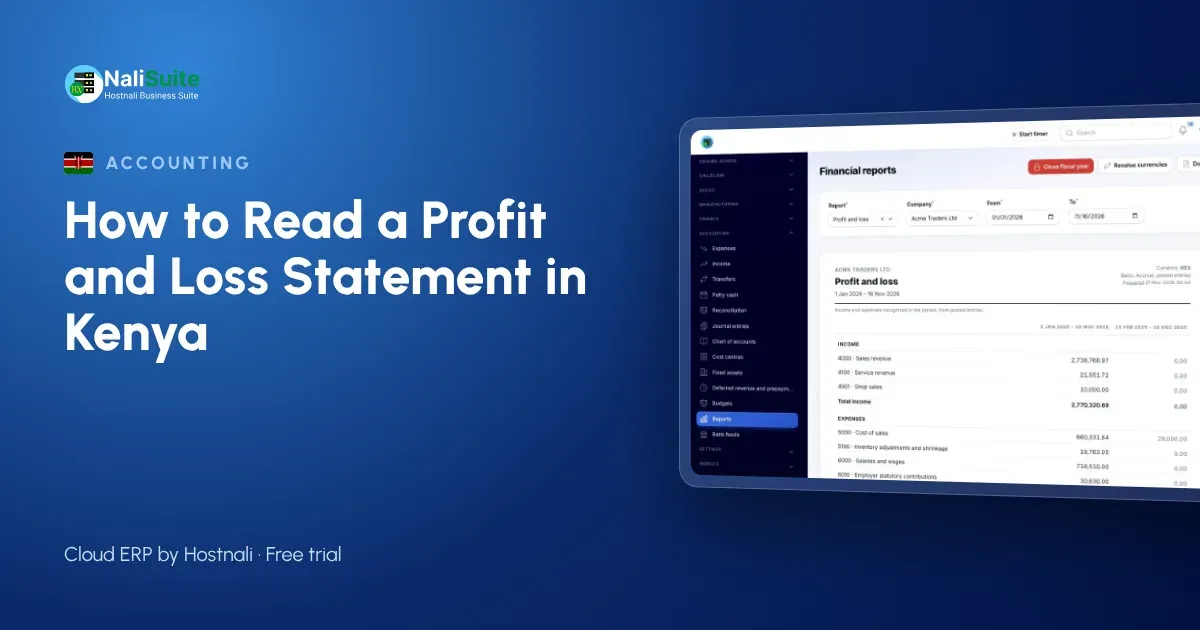
That page is the most useful report a small business owner has. This guide walks through a profit and loss statement (P&L) the way Wanjiru should read it, line by line, with the questions to ask at each step.
What the P&L actually measures
A profit and loss statement, also called an income statement, covers a period: a month, a quarter or a year. It answers one question: over that period, did the business earn more than it cost to run?
It is not the same as your M-Pesa balance or your bank balance. A customer who took cement on credit in March appears as a sale in March, even if the money only lands in May. A delivery van bought in cash appears in the P&L slowly, as depreciation over several years, not as one big cost in the month you paid. This is why a business can show a profit and still struggle to pay suppliers, a gap we cover in our cash flow tips for Kenyan businesses.
Reading it from the top down
1. Revenue (sales)
The first line is everything you invoiced or sold in the period, before any costs. Check two things here. First, is it complete? Cash sales at the counter, till payments, bank transfers from contractors and credit sales should all be in it. Second, is VAT excluded? If you are VAT registered, the VAT you collect belongs to KRA and should not sit inside your revenue.
2. Cost of sales
Directly below revenue is what the goods you sold cost you. For Wanjiru, that is the cost of the cement, iron sheets and paint that left the shop, not everything she bought. Stock still on the shelves is not a cost yet.
If your cost of sales jumps while sales stay flat, the usual reasons are a supplier price rise you did not pass on, theft or breakage, or stock that was never counted properly.
3. Gross profit and gross margin
Revenue minus cost of sales gives gross profit. Divide gross profit by revenue and you have the gross margin, a percentage you can compare month to month. Suppose Wanjiru’s margin is 24% in one quarter and 19% the next. Nothing else on the page matters as much as finding out why five points disappeared.
4. Operating expenses
These are the costs of keeping the doors open whether you sell one bag of cement or a thousand: rent, salaries, electricity, transport, airtime and data, M-Pesa and bank charges, repairs and licences. Read each line and ask whether it is in line with last month. Small charges add up. Transaction costs on a busy till, for example, are a real expense and should have their own line rather than being buried in “sundries”.
5. Operating profit
Gross profit minus operating expenses is your operating profit: what the trading activity itself earned. This is the number to watch when you decide whether to open a second branch or hire another sales assistant.
6. Interest, tax and net profit
Below operating profit come interest on loans or overdrafts and the income tax charge. What remains is net profit, the amount that belongs to the owners. Your accountant will work out the tax figure with you; check the current rules with KRA, as they change from time to time.
A quick sample reading
Here is how Wanjiru might read a quarter that looks fine at first glance:
| Line | This quarter | Last quarter | What to ask |
|---|---|---|---|
| Revenue | Up 10% | Did prices rise, or volumes? | |
| Gross margin | 19% | 24% | Which products lost margin? |
| Staff costs | Up 30% | Was the extra casual worker needed every week? | |
| Transaction charges | Up 15% | Would a paybill with account numbers cost less to reconcile? | |
| Net profit | Down | Sales growth hid a margin problem |
Higher sales with lower profit is one of the most common patterns in Kenyan retail. It usually means discounts, supplier price rises or stock losses, and the P&L is where you first see it.
Mistakes that make a P&L misleading
- Personal spending in business costs. School fees paid from the till or a family phone bill inflate expenses and hide the real profit. Keep them out (see our guide to separating business and personal money).
- Missing sales. Cash sales that never get recorded make the business look weaker than it is, which hurts when you apply for credit.
- No stock count. Without a count at the end of the period, cost of sales is a guess.
- Owner’s drawings shown as salary, or not at all. Decide with your accountant how the owner is paid and record it the same way every month.
Make it a monthly habit
A yearly P&L tells you what went wrong months ago. A monthly one lets you fix it. Set aside an hour in the first week of each month to compare the last month with the month before and with the same month last year, line by line.
In NaliSuite Accounting, the P&L, balance sheet and cash flow statement build themselves from your daily work: every invoice, supplier bill, payslip and till sale posts to the ledger as it happens, with a comparison to the prior period on the same screen. Bank and M-Pesa reconciliation keeps the figures honest, so the report reflects money that really moved. Sales from the Point of Sale till and supplier bills from Purchases land in the right lines without retyping.
Frequently asked questions
Is profit the same as the money in my M-Pesa account?
No. Profit counts sales when they are made and costs when they are incurred. Your M-Pesa or bank balance shows cash, which also includes loans, owner’s money and unpaid VAT.
How often should a small business look at its P&L?
Monthly is a good rhythm for most businesses in Kenya. Busy retailers sometimes check gross margin weekly.
Does KRA need my profit and loss statement?
Your income tax return is based on your profit, so your figures need to be supported by proper records. Ask your accountant or KRA what your business must file.
What is a healthy gross margin?
It depends on the trade. Compare your own margin over time and against businesses like yours rather than chasing one number.
Try NaliSuite
NaliSuite gives you a live profit and loss statement without spreadsheets, from Ksh 250 a month with a free trial. See the plans and read the numbers every month, not once a year.