 KES
 UGX - Uganda
 TZS - Tanzania
 RWF - Rwanda
 NGN - Nigeria
 ZAR - South Africa
 USD - Zimbabwe
 GHS - Ghana
 ETB - Ethiopia
 ZMW - Zambia
 USD - International

Otieno sells phone accessories from a stall in Kisii town. Customers pay to his personal M-Pesa number. From the same number he pays his supplier in Nairobi, buys lunch, sends money home, pays his daughter’s school fees and tops up his airtime. At the end of the month the balance is lower than he expected and he has no idea whether the stall made a profit or whether he simply spent it.
This is the most common money problem in small Kenyan businesses, and also one of the easiest to fix. This guide shows how to separate business and personal money in practical steps, starting with the one that matters most.
Why mixing money hurts the business
- You cannot see your profit. When personal spending runs through the business, every report is wrong. Our guide to reading a profit and loss statement only helps if the numbers inside it are business numbers.
- Tax gets harder. KRA expects your income tax return to be supported by records. Proving which payments were business costs is difficult when they sit among family transfers.
- Credit gets harder. Lenders look at statements to judge the business. A statement full of personal transactions makes the business look smaller and riskier.
- Growth gets harder. You cannot hand the books to an accountant, a partner or a manager when half of them are private.
Step 1: Give the business its own M-Pesa channel
Your personal line should stop receiving customer payments. Options, from simplest:
- A Buy Goods till number for counter sales.
- A paybill number for customers who buy on credit, so they can enter the invoice number as the account number.
- A separate SIM for the business if you are not ready for a till or paybill yet, used only for business.
Print the till or paybill number on your receipts, invoices, signboard and WhatsApp catalogue, so customers stop asking for your personal number.
Step 2: Open a business bank account
A bank account in the business name, or in your name but used only for the business, gives you a monthly statement that becomes the backbone of your records. Sweep the till balance to this account on a regular day each week. If your business is registered as a company, a business account is the normal arrangement. Registration itself is done through the Business Registration Service on eCitizen.
Step 3: Pay yourself on purpose
Most owners mix money because they take what they need when they need it. Replace that with a fixed amount on a fixed day:
- Sole proprietors and partners usually take drawings: a transfer from the business account to the personal account, recorded as drawings, not as an expense.
- Company directors can be paid a salary through payroll, with PAYE and the other statutory deductions; our PAYE payroll page covers how NaliSuite works them out. Talk to your accountant about which suits you.
Start with an amount the business can clearly afford, even if it is small. Raise it when the profit supports it.
Step 4: Stop paying personal bills from the business
This sounds obvious, but it needs a rule everyone in the family understands. School fees, rent at home, household shopping and family emergencies are paid from your personal account, which is funded by your pay or drawings. If the business genuinely lends you money one month, record it as a loan to the owner and repay it.
Step 5: Keep a receipt for every business cost
For each business payment, keep the supplier’s invoice or receipt. A photo on your phone is better than nothing, but a system where receipts are attached to the expense is better still. NaliSuite Purchases records supplier bills, and you can upload or photograph a bill so Document AI fills in the details for you to check.
Step 6: Reconcile every week
Once a week, go through the business M-Pesa and bank statements and make sure every line is explained: a sale, a supplier payment, an expense, a transfer between your own accounts, or your drawings. Anything personal that slipped through gets recorded as drawings and you remind yourself of the rule.
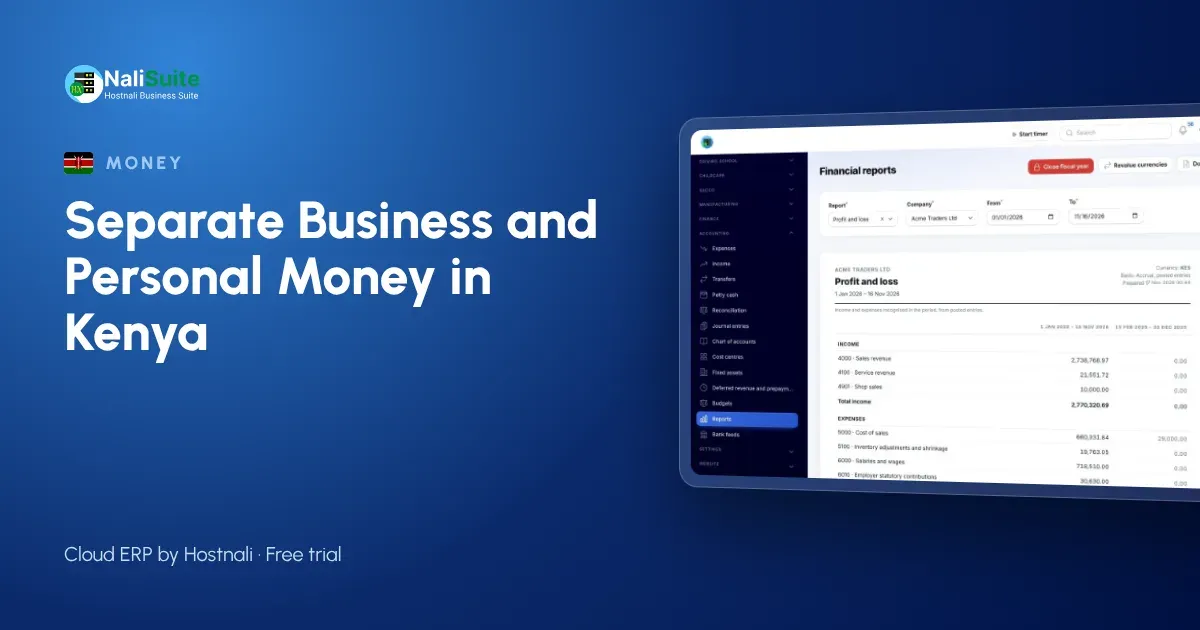
Bank and M-Pesa reconciliation in NaliSuite imports the statements and suggests matches against invoices and bills, so the weekly check takes minutes.
Otieno’s new setup
| Before | After |
|---|---|
| Customers pay his personal number | Customers pay a Buy Goods till |
| Supplier paid from personal M-Pesa | Supplier paid from the business bank account |
| Spends from takings as needed | Takes a fixed amount every Friday as drawings |
| No receipts | Supplier invoices photographed and attached |
| No idea of monthly profit | Monthly profit and loss from clean records |
Within two months he can see that the stall is profitable, but that a quarter of his gross profit was going on transport to collect stock. He now orders by WhatsApp and pays for delivery, which costs less.
When the business is a family affair
In family businesses, relatives may work in the shop and take goods or cash informally. Agree on simple rules: family members who work are paid a wage or an allowance, goods taken for the house are recorded at cost as drawings, and nobody takes cash from the till without writing it down.
Frequently asked questions
Do I need a registered business to separate my money?
No. A separate till, SIM or bank account used only for the business is a good start. Registration helps when you open a business bank account or apply for credit.
Are my drawings a business expense?
No. Drawings are the owner taking profit out of the business. They reduce your capital, not your profit.
What if I use one phone for everything?
Use a dual-SIM phone with a business line, or a till number, so business and personal M-Pesa never share a balance.
How does this help with a loan?
Clean statements show what the business really earns. See our list of records for a business loan in Kenya.
Try NaliSuite
Keep business money on its own books, with every till, M-Pesa and bank payment matched for you. NaliSuite starts at Ksh 250 a month with a free trial. See the plans, or start with the Accounting app.