 KES
 UGX - Uganda
 TZS - Tanzania
 RWF - Rwanda
 NGN - Nigeria
 ZAR - South Africa
 USD - Zimbabwe
 GHS - Ghana
 ETB - Ethiopia
 ZMW - Zambia
 USD - International

Chebet runs a bakery in Eldoret that supplies supermarkets and schools. She wants to buy a second oven so she can take a large school contract. Her bank, a SACCO and a microfinance lender all say the same thing when she asks about a loan: bring your records. None of them gives her quite the same list, and she has three weeks to pull everything together.
This guide sets out the records Kenyan lenders usually ask for, why they ask for each one, and how to keep them ready so the next application takes days, not weeks. Every lender has its own requirements and decision process, so treat this as a preparation list, not a guarantee of approval.
1. Who you are and what the business is
- Your national ID and those of other directors or partners.
- Business registration documents from the Business Registration Service: a business name certificate, or for a company, the certificate of incorporation and the current list of directors and shareholders (CR12).
- Business permit from your county, where your trade needs one.
- Lease agreement for your premises, if you rent.
Lenders use these to confirm that the business exists, who owns it and who can sign for it.
2. Tax records
- KRA PIN for you and for the business if it is a company.
- Tax compliance certificate from KRA, which many lenders ask for and which shows your returns and payments are up to date.
- Recent tax returns, and VAT returns if you are registered.
If your returns are not current, fix that before you apply. A missing tax compliance certificate stops many applications early.
3. Statements that show money moving
- Bank statements for the business accounts, usually covering several months, often six or twelve.
- M-Pesa statements for your till or paybill over the same period, downloaded from the business portal.
For many Kenyan businesses, the M-Pesa statement is the clearest proof of daily sales. It is also where mixed money shows up: personal transfers, family support and school fees in a business statement make the business look smaller and less predictable. If that sounds familiar, read our guide to separating business and personal money in Kenya and start now; every clean month helps.
4. Financial statements
- Profit and loss statement and balance sheet for the last one to three years, depending on the lender and the loan size. Larger loans may need statements prepared or audited by an accountant.
- Management accounts for the months since the last year-end: the same reports, prepared monthly.
Lenders read these to judge whether the business earns enough to repay. Our guide to reading a profit and loss statement explains what they look for, from gross margin to whether operating profit covers interest.
5. Who owes you and whom you owe
- Debtors list (aged receivables): customers who owe you money, how much and for how long.
- Creditors list: suppliers you owe.
- Existing loans: lender, balance and repayment schedule for each.
Chebet’s school and supermarket customers pay on 30 to 60 day terms. Her debtors list shows the lender that money is coming in, and from whom.
6. The plan for the money
- What the loan is for, with quotations for equipment or stock.
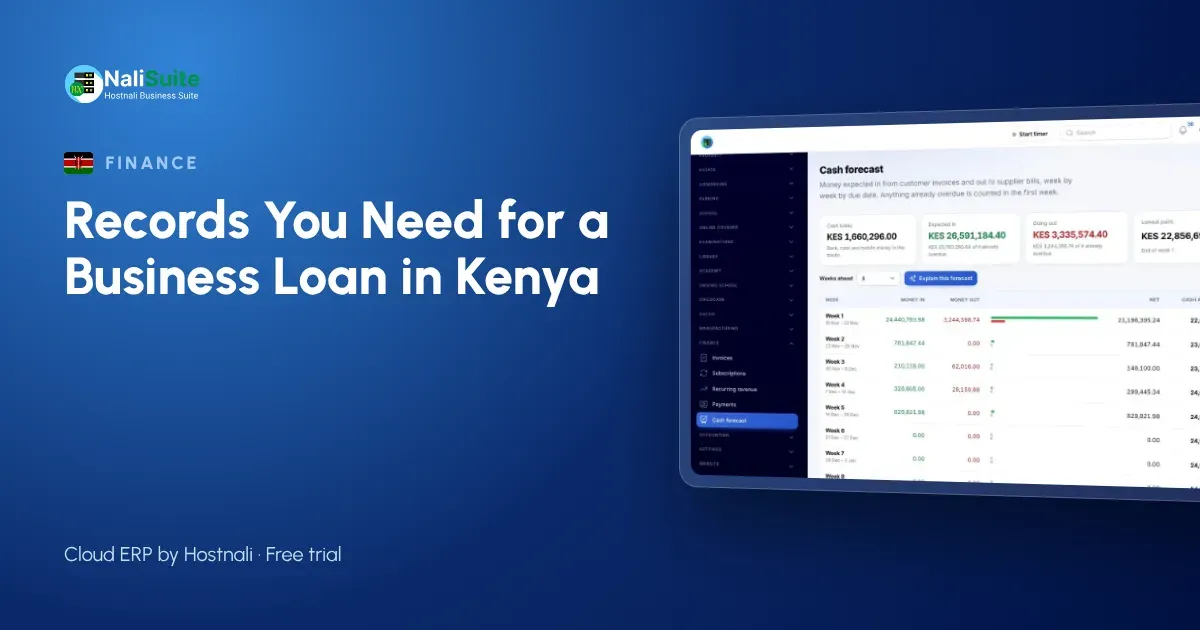
- A cash flow forecast for the loan period showing how repayments will be met; our cash flow tips for Kenyan businesses explain how to build one.
- Contracts or purchase orders that support the forecast, such as Chebet’s school supply contract.
7. Security, if asked
Some loans need collateral or guarantees: a logbook for a vehicle, a title deed, chattels, or guarantors. Lenders also check your credit history with credit reference bureaus. Pay existing loans and supplier accounts on time; your history follows you.
A checklist you can print
| Record | Where it comes from | Keep updated |
|---|---|---|
| IDs and registration | You, BRS on eCitizen | When directors change |
| KRA PIN, compliance certificate | KRA iTax | Renew before it expires |
| Bank and M-Pesa statements | Bank, M-Pesa business portal | Monthly |
| P&L and balance sheet | Your accounts | Monthly and yearly |
| Debtors and creditors lists | Your invoicing and purchases | Weekly |
| Loan schedule | Your lenders | When it changes |
| Forecast and quotations | You | For each application |
Keeping records loan-ready all year
The businesses that get finance quickly are rarely the ones that work hardest on the application. They are the ones whose records are always up to date. In NaliSuite Accounting, every invoice, bill, payslip and till sale posts to the books as it happens, so the profit and loss statement, balance sheet and cash flow statement are ready whenever a lender asks. Invoicing keeps an aged debtors list, bank and M-Pesa reconciliation shows that the books match your statements, and Documents holds registration papers, contracts and certificates in one place to share securely.
Frequently asked questions
How many months of statements do lenders want?
It varies by lender and loan. Six to twelve months is common; ask the lender before you apply.
Can I get a loan without audited accounts?
Many smaller loans are assessed on statements and management accounts. Larger loans more often need accountant-prepared or audited statements.
Does my M-Pesa statement count?
Many lenders accept M-Pesa business statements as evidence of sales, alongside bank statements.
Will clean records guarantee a loan?
No. Lenders consider many factors. Clean, complete records make your application easier to assess and faster to process.
Try NaliSuite
Keep your books lender-ready every month. NaliSuite starts at Ksh 250 a month with a free trial. See the plans.